Why Does Living With ADHD Feel So Overwhelming Today?
If you live with ADHD, chances are you’ve thought this at least once:
“Is it just me… or does everything feel louder, faster, and harder to manage than it used to?”
You’re not imagining it.
We live in a digital world designed to pull attention in a hundred directions at once — notifications, social media, emails, messages, and endless tabs open “just in case.” For someone with ADHD, this environment doesn’t just distract. It can completely derail focus, energy, sleep, and emotional regulation.
ADHD isn’t new. But ADHD in the digital age often feels more intense because of constant stimulation. Many children, teens, and adults struggle not because they lack ability — but because their nervous systems are overloaded.
At The Insight Clinic, an ADHD clinic in Ontario serving Whitby and Durham Region, families often tell us:
“We’re not lazy. We’re exhausted from trying to keep up.”
The good news? ADHD symptoms and treatment options have evolved. With thoughtful, personalized support, it is possible to build systems that work — even in a fast-paced, tech-heavy world.
How Do ADHD Symptoms Show Up in the Digital Age?
ADHD looks different for everyone. But in today’s environment, certain patterns are common:
- Losing hours scrolling without meaning to
- Jumping between apps, tabs, and tasks
- Feeling overwhelmed before starting
- Hyperfocusing on one thing while everything else disappears
- Forgetting deadlines or digital files
- Struggling to transition away from screens
This isn’t a motivation problem. It’s an executive functioning and nervous system regulation challenge.
Technology intensifies time blindness, impulsivity, and distraction — especially when dopamine-driven platforms are designed to keep attention hooked.
At The Insight Clinic, ADHD treatment begins with understanding — not correcting. When people understand how their brain works, shame softens. From there, practical change becomes possible.
ADHD and Screen Overstimulation: Why Does It Hit So Hard?
One of the most common modern challenges is ADHD and screen overstimulation.
Many individuals with ADHD already experience:
- Heightened sensory sensitivity
- Difficulty with transitions
- Intense emotional reactions
- Nervous system dysregulation
Add constant notifications, bright screens, pressure to respond instantly, and multitasking demands — and the system rarely gets a chance to reset.
This is why ADHD symptoms often worsen after extended screen time. It’s not simply distraction. It’s nervous system overload.
At The Insight Clinic in Whitby, ADHD treatment often begins with regulation — not productivity. When the nervous system feels safer and calmer, focus improves naturally.
How Does Sleep Affect ADHD Symptoms?
Sleep and ADHD are closely connected — especially in the digital age.
Many children, teens, and adults with ADHD struggle with:
- Delayed sleep schedules
- Racing thoughts at night
- Difficulty waking up
- Inconsistent energy levels
Screens can make this worse. Blue light exposure and late-night stimulation can disrupt melatonin production, making it harder for the brain to wind down. For someone already navigating ADHD and screen overstimulation, sleep disruption can intensify inattention, emotional reactivity, and impulsivity the next day.
Improving sleep doesn’t cure ADHD — but it can significantly reduce symptom intensity.
At The Insight Clinic in Whitby, ADHD treatment often includes practical sleep hygiene strategies alongside therapy and skill-building. Small changes — such as consistent wind-down routines, screen cut-off times, and nervous system regulation techniques — can make a meaningful difference.
When Should You Consider an ADHD Assessment?
Many people wonder:
“Do I actually have ADHD — or am I just overwhelmed?”
Online quizzes can offer insight. But a comprehensive ADHD assessment provides clarity.
A professional ADHD test or psychoeducational assessment looks at:
- Attention and impulse control
- Executive functioning
- Emotional regulation
- Developmental history
- Academic or workplace performance
- Overlapping anxiety or mood concerns
At The Insight Clinic, ADHD assessments and psychoeducational assessments are collaborative and thorough — never rushed. A diagnosis isn’t about labeling. It’s about understanding how to support the brain you already have.
If you’re unsure whether ADHD testing would be helpful, an initial consultation can clarify next steps.
Is Technology Making ADHD Worse — or Can It Help?
Technology can worsen ADHD symptoms — but it can also support them.
Yes, dopamine-driven apps may:
- Interfere with sleep
- Increase impulsivity
- Make boring tasks feel impossible
But technology can also help when used intentionally:
- Digital planners reduce memory load
- Timers improve time awareness
- Website blockers protect focus
- Visual reminders support organization
ADHD treatment in Whitby often includes helping clients build ADHD-friendly systems — not perfection. The goal isn’t eliminating screens. It’s reducing friction between intention and action.
ADHD and Emotional Regulation: The Overlooked Piece
ADHD doesn’t just affect attention. It affects emotions and relationships.
Many individuals experience:
- Emotional overwhelm
- Sensitivity to criticism
- Impulsivity in conversations
- Anxiety or low self-esteem
This emotional component is often missed — especially in high-achieving children and adults who “look fine.”
Psychotherapy can play an important role here. At The Insight Clinic, therapy for ADHD focuses on:
- Emotional regulation
- Self-compassion
- Reducing shame
- Building sustainable coping strategies
ADHD is not a character flaw. It’s a differently wired nervous system that benefits from informed support.
ADHD at School and Work
ADHD often becomes most visible in environments that demand constant executive functioning.
Students may struggle with:
- Assignment tracking
- Organization
- Sustained attention
Adults may struggle with:
- Task initiation
- Deadlines
- Meeting fatigue
- Burnout
At The Insight Clinic, ADHD treatment may include:
- Psychotherapy
- Tutoring and learning support
- Academic strategy building
- Parent training and coaching
Tutoring isn’t just academic — it helps students understand how they learn best. When students feel supported instead of corrected, confidence grows.
ADHD in Teens and Adults: Why Diagnosis Later in Life Matters
Many adults are diagnosed with ADHD years after struggling silently.
Is ADHD Affecting Your Daily Life?
Discover how focus, impulsivity, and mental energy may be influencing your routines.
A later diagnosis often brings relief — and grief.
Relief in understanding.
Grief for years spent feeling “not good enough.”
Therapy during this stage can help individuals:
- Reframe past experiences
- Release unrealistic expectations
- Build systems that finally work
An adult ADHD test isn’t about rewriting the past. It’s about making the future more manageable.
ADHD Burnout: When Coping Stops Working
Many individuals with ADHD spend years overcompensating.
They work longer hours.
They rely on last-minute adrenaline.
They mask their struggles.
They push through exhaustion.
Over time, this can lead to ADHD burnout — a state of mental and emotional fatigue that feels very different from typical stress.
ADHD burnout may look like:
- Increased procrastination
- Emotional shutdown
- Loss of motivation
- Heightened anxiety or irritability
- Feeling “stuck” despite trying harder
In the digital age, constant accessibility makes burnout more likely. There’s rarely true downtime.
At The Insight Clinic, ADHD treatment includes helping individuals move away from survival-based coping and toward sustainable systems. Therapy often focuses on pacing, boundaries, realistic expectations, and nervous system regulation — especially for high-achieving adults who have silently struggled for years.
Burnout isn’t laziness. It’s a signal that the current system isn’t working.
Is Medication the Only ADHD Treatment?
Medication can be an important tool for many individuals. It may help with:
- Attention
- Impulse control
- Mental stamina
But medication works best as part of a broader plan.
Effective ADHD symptoms and treatment strategies often include:
- Psychotherapy
- Structured routines
- Skill-building
- Environmental supports
- Parent coaching
At The Insight Clinic, we view medication as one option — not the only option.
Neurofeedback for ADHD in Durham Region
Some families explore neurofeedback for ADHD in Durham Region as a complementary support.
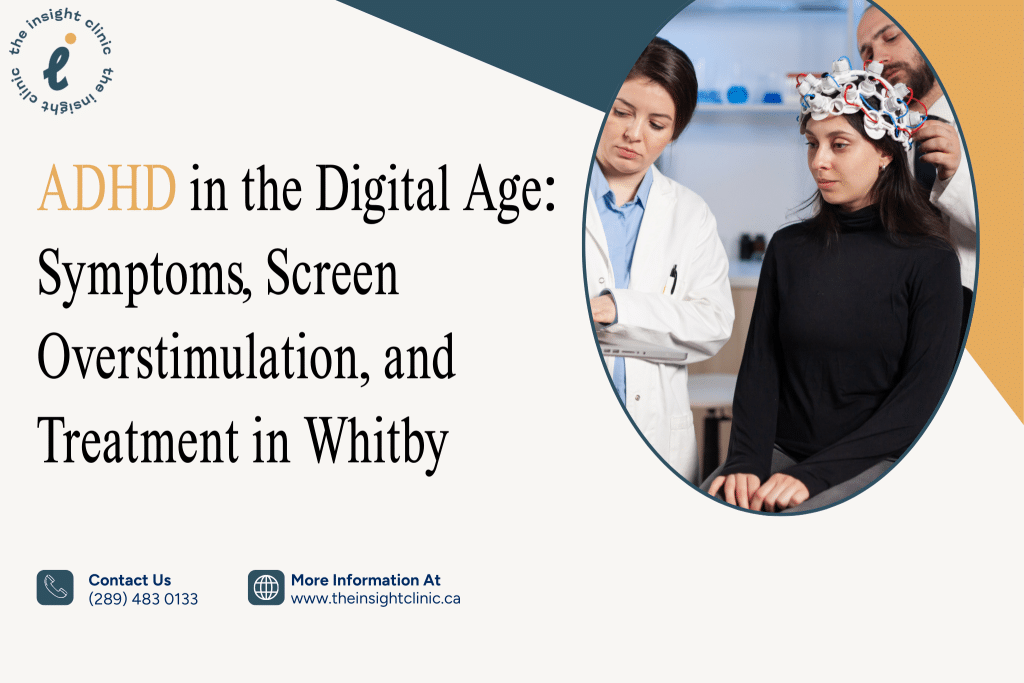
Neurofeedback uses EEG-based feedback to increase awareness of brain activity. Over time, this may support self-regulation.
It’s important to clarify:
- Neurofeedback is not a cure.
- Research continues to evolve.
- Results vary between individuals.
At The Insight Clinic, neurofeedback therapy is integrated thoughtfully alongside psychotherapy, academic support, and (when appropriate) medication.
Who might consider neurofeedback?
- Individuals struggling with emotional regulation
- Those sensitive to stress or overwhelm
- Families seeking a non-medication-based complementary option
- Clients wanting to strengthen self-regulation skills
At The Insight Clinic, we help families carefully consider which supports are most likely to be helpful — so their time and energy are used intentionally.
Why Early ADHD Support Matters
When ADHD is supported early:
- Self-esteem is protected
- Anxiety may be reduced
- Family relationships strengthen
- Burnout risk decreases
ADHD support isn’t static. It evolves across life stages.
At The Insight Clinic in Whitby, ADHD treatment plans are flexible and personalized — designed for sustainability, not perfection.
What Strengths Often Come With ADHD?
While ADHD presents challenges, it can also come with strengths that are often overlooked.
Many individuals with ADHD demonstrate:
- Creative problem-solving
- High energy and enthusiasm
- Strong intuition
- Hyperfocus on meaningful tasks
- Innovative thinking
The goal of ADHD treatment isn’t to eliminate personality or intensity. It’s to reduce unnecessary suffering while preserving strengths.
At The Insight Clinic, support focuses on helping individuals understand both sides of ADHD — challenges and abilities — so they can build a life that works with their brain, not against it.
Reclaiming Focus in a Distracted World
Living with ADHD in the digital age is challenging — but not hopeless.
With the right support, individuals can:
- Reduce overwhelm
- Improve focus
- Strengthen emotional resilience
- Build confidence
ADHD comes with challenges — but also creativity, innovation, and insight.
ADHD Treatment in Whitby and Durham Region
The Insight Clinic supports children, teens, and adults through:
- ADHD testing and psychological assessment
- Psychoeducational assessments
- Psychotherapy
- Tutoring and academic support
- Parent training and coaching
- Neurofeedback therapy
As an ADHD clinic in Ontario serving Whitby and Durham Region, our approach is collaborative, ethical, and individualized.
If you’re feeling overwhelmed or unsure where to start, you don’t have to navigate ADHD alone. If you’d like to explore ADHD treatment in Whitby, Ontario gives us a call or schedule a initial consult to learn more.
Frequently Asked Questions About ADHD in the Digital Age
Can screen time make ADHD symptoms worse?
For many people, yes. Excessive screen time can intensify ADHD symptoms such as distractibility, impulsivity, emotional dysregulation, and difficulty transitioning between tasks. Digital platforms are designed to deliver fast, rewarding feedback, which can be especially challenging for ADHD brains to disengage from. That said, technology can also be supportive when used intentionally and with clear structure.
How do I know if I or my child should get an ADHD test?
If ADHD symptoms are consistently affecting daily functioning — at school, work, relationships, or emotional well-being — an ADHD test or professional assessment may be helpful. Online quizzes can provide initial insight, but a formal assessment offers clarity, context, and guidance for next steps. An evaluation can help determine whether ADHD is present and what types of support may be most appropriate.
Can ADHD be managed without medication?
Yes, many individuals manage ADHD symptoms without medication or alongside medication. Non-medicated supports often include psychotherapy, structured routines, environmental adjustments, emotional regulation strategies, tutoring or academic support, and nervous system regulation. The most effective approach varies from person to person and often involves a combination of supports rather than a single solution.
What role does psychotherapy play in ADHD support?
Psychotherapy can be an important part of ADHD care, especially when emotional regulation, anxiety, self-esteem, or burnout are present. Therapy may help individuals better understand how their ADHD symptoms affect daily life, build coping strategies, reduce shame, and strengthen emotional resilience. Psychotherapy supports both practical skills and emotional well-being.
Is neurofeedback therapy effective for ADHD?
Neurofeedback therapy is sometimes explored as a complementary support for ADHD. It uses EEG-based feedback to increase awareness of brain activity and may support self-regulation over time for some individuals. Neurofeedback therapy is not a primary or stand-alone ADHD treatment and is most appropriately used as part of a broader care plan that may include psychotherapy, routines, tutoring, or ADHD medication.
Why does ADHD feel harder in the digital age?
The modern digital environment increases stimulation, multitasking, and demands on attention — all of which can be especially challenging for individuals with ADHD. Constant notifications, fast-paced content, and screen-based tasks can overwhelm the nervous system, making focus, organization, and emotional regulation more difficult than in less digitally saturated environments.
How can tutoring help students with ADHD?
ADHD-informed tutoring focuses on more than academics alone. It supports organization, planning, task initiation, and confidence while adapting to how a student learns best. For many students with ADHD, tutoring can reduce overwhelm, improve follow-through, and help them build skills that support long-term academic success.
Is it ever too late to seek ADHD support?
No. ADHD support can be helpful at any stage of life. Many adults are diagnosed later in life and find that understanding their ADHD brings relief and clarity. Whether support begins in childhood, adolescence, or adulthood, learning how to work with an ADHD brain — rather than against it — can significantly improve quality of life.

Clinical Review by Gretchen Savery
Gretchen Savery, Registered Psychotherapist (Qualifying), supports The Insight Clinic’s blog review and approval process by helping ensure content is accurate, thoughtful, and aligned with professional standards, including CRPO expectations around ethical communication, client confidentiality, and responsible mental health education. Her role helps strengthen the quality, clarity, and trustworthiness of the clinic’s educational resources.

Blog Writer Bio — Dr. Betsy Bautista
Dr. Betsy Bautista is an experienced medical doctor and mental health counsellor contributing educational content for The Insight Clinic. With a strong background in supporting adults and seniors, she brings clinical insight, compassion, and a deep understanding of emotional health, aging, grief, chronic illness, family relationships, anxiety, depression, and life transitions. Her writing helps make complex mental health topics easier to understand while supporting The Insight Clinic’s commitment to thoughtful, accessible, and evidence-informed education.