Table of Contents
Introduction: Why Families Are Exploring Play Therapy
Across the world, children face challenges that are often invisible to adults. Anxiety, grief, trauma, and behavioural struggles may show up as tantrums, withdrawal, or restlessness rather than words. For adults, therapy often begins with conversation. For children, it often begins with something more natural: play.
This is the principle behind play therapy (also called therapeutic play or child-centred therapy). It offers a safe, structured environment where toys, art, and imagination become tools for healing. Families from Toronto to Tokyo, from rural communities to urban centres in Europe, are increasingly integrating play therapy into their child’s mental health support.
In Whitby, Durham Region, and across the GTA, clinics such as The Insight Clinic incorporate play therapy into child and family services. But while the practice is local, the principles are global and evidence-informed.
This guide explains what play therapy is, the science behind it, how it works, the conditions it may support, and why access matters.
What Is Play Therapy?
Play therapy is a specialized form of psychotherapy (or therapeutic intervention) that uses play as the medium of communication. It is most commonly used with children aged 3–12, and can be adapted (in certain models) for older children or parent-child dyads.
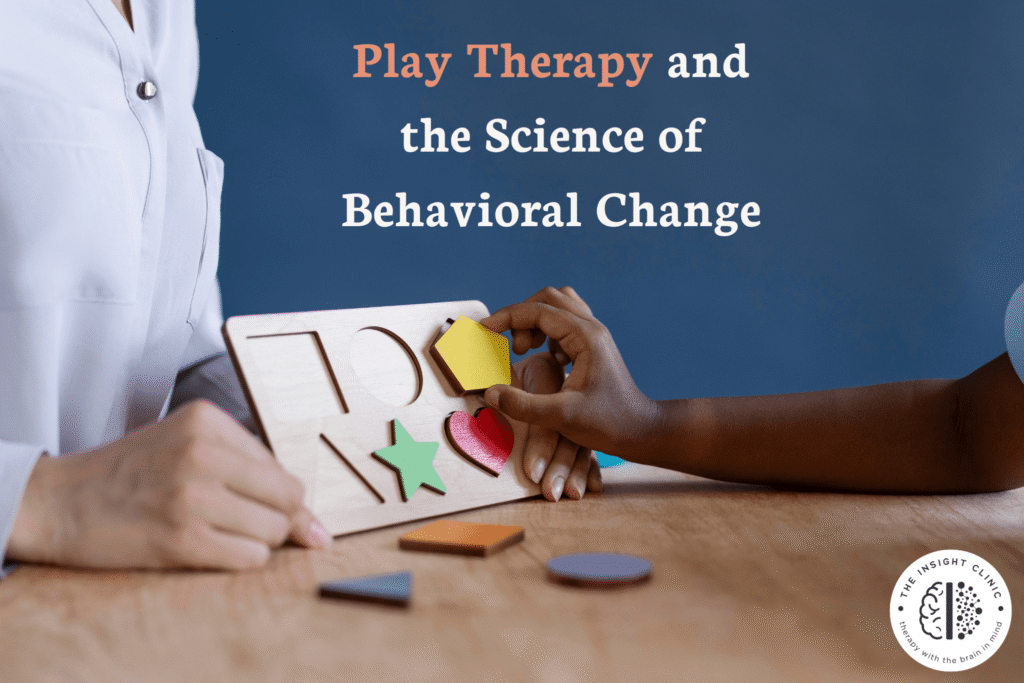
The foundational idea is that play is the child’s language, and toys are their words. Through play, children express feelings, rehearse experiences, and explore their inner world. A trained therapist observes, reflects, and gently guides the process, helping children gradually make sense of their experiences.
For example, a child who has witnessed conflict at home might stage battles with toy soldiers; another who has experienced loss may draw broken hearts or role-play themes of separation. In each case, play becomes a bridge between internal emotions and external expression.
Unlike casual play, therapeutic play is guided, intentional, and facilitated by a professional trained to recognize themes, foster trust, and encourage adaptive coping skills.
A Brief History of Play Therapy
The evolution of play therapy mirrors developments in both psychology and child development.
- Psychoanalytic Beginnings: Sigmund Freud and early psychoanalysts observed symbolic play as an expression of unconscious conflict. His daughter Anna Freud extended these ideas to children.
- Child-Centred Movement: In the mid-20th century, Virginia Axline (influenced by Carl Rogers) developed child-centered play therapy, emphasising acceptance, empathy, and allowing children to lead their healing through play.
- Global Expansion: By the 1970s and 1980s, play therapy was integrated into schools, hospitals, and community programs worldwide. Professional associations emerged in North America, Europe, Asia, and beyond.
- Modern Practice: Today, play therapy is considered a research-supported intervention in child mental health, used in settings from schools to clinics to humanitarian programs.
This evolution reflects a growing recognition that children require therapeutic approaches aligned with their natural modes of communication.
The Science Behind Play Therapy
Neurological & Biochemical Foundations
Several mechanisms may help explain why play therapy can support behavioural and emotional change:
- Neurotransmitters: Engaging in play is correlated (in some studies) with increases in dopamine, serotonin, and endorphins, which support positive mood and motivation.
- Neuroplasticity: Repeated engagement supports formation and strengthening of neural pathways, enabling improved emotional regulation over time.
- Prefrontal Cortex Engagement: Play often activates brain regions involved in impulse control, decision-making, and empathy.
- Stress Regulation: Some research indicates that children’s play can lower cortisol (a stress hormone), especially in therapeutic or hospital contexts. PubMed
Because of these underlying neurobiological processes, play therapy may help children rewire responses to stress, trauma, or behavioural challenges.
Relational & Developmental Mechanisms
- Attachment & Trust: A secure therapeutic bond acts as a corrective relational experience, helping children internalize regulation.
- Mirror Neurons & Modeling: Observing a calm, attuned therapist may help children internalize self-regulation.
- Symbolic Play: Toys, art, and narratives allow children to externalize inner conflict in a developmentally appropriate way.
In short, play therapy works through biological, relational, and symbolic channels.
Why Play, Not Talk?
Unlike adults, children often cannot articulate complex inner experiences. Play provides symbolic expression. A doll can represent a parent, a block tower can symbolize stability, and a broken drawing can embody grief. Through this symbolism, children can process what would otherwise remain unspoken.
How Play Therapy Works in Practice
Play therapy typically occurs in a thoughtfully arranged playroom filled with toys, art supplies, puppets, sand trays, blocks, and more. The tools are selected to provide symbolic range and therapeutic possibility.
Key Approaches
Directive Play Therapy
- Therapist leads the session with structured activities to address specific themes.
- Example: Using puppets to model conflict resolution or role-play anger management.
Non‑Directive / Child-Centered Play Therapy
- Child leads; therapist follows, reflecting and supporting.
- The child’s choices drive the narrative.
Filial / Family-Inclusive Play Therapy
- Parents or caregivers may participate.
- Example: A parent joins in play, then practices reflective listening at home.
Session Structure
A typical session may include:
Tension or Conflict Showing Up Often?
Understand how stress and communication styles may be affecting your relationship.
- Warm-up / Free play — helps the child feel safe and settled.
- Exploration / Thematic play — child explores or interacts with materials; therapist observes.
- Reflection / Therapeutic input — therapist mirrors, comments, or introduces strategies (depending on model).
- Closure — calming activity or ritual to help the child feel grounded.
Sessions often last 45–60 minutes and occur weekly or biweekly. Change is generally gradual; consistent engagement supports deeper shifts over time.
Conditions Play Therapy May Support
Play therapy is adaptable and used to address a broad range of challenges. It may support children facing:
- Anxiety & Phobias — role-play helps children face fears in a safe space.
- Depression / Low Mood — creative play can offer a sense of mastery and expression.
- ADHD & Focus Difficulties — structured play may help with impulse control, patience, turn-taking.
- Trauma & PTSD — symbolic play allows children to process overwhelming experiences indirectly.
- Grief & Loss — art, stories, and play help externalize emotions of separation.
- Autism Spectrum / Social Challenges — play therapy can support flexibility, emotional regulation, social narratives, communication.
- Behavioral & Emotional Regulation — children practice alternate responses to frustration, conflict, anger through play.
Each child is different. Play therapy does not guarantee resolution, but many clinicians and families report meaningful shifts over time.
Benefits of Play Therapy
Many potential benefits are reported by clinicians, families, and in research (where available).
- Emotional Expression: Children gain healthier avenues to express inner feelings.
- Self-Esteem & Mastery: Achieving small successes in play can reinforce confidence.
- Social & Peer Skills: Empathy, cooperation, and perspective-taking often improve.
- Coping & Self-Regulation: Techniques learned in play can generalize to daily stressors.
- Family Insight: Therapists often share reflections with caregivers, improving communication.
- Academic & School Benefits: Some children show improved engagement, focus, or behaviour at school (as reported by parents/teachers).
- Sustained Impact: Some longitudinal studies and reviews suggest that benefits may persist beyond the active therapy period, particularly when combined with caregiver support.
These ripple effects can extend beyond the therapy room into home, school, and community life.
Safety and Evidence Base
Play therapy is generally considered low risk when conducted by trained, regulated professionals. It avoids pharmacological side effects. Some children may feel emotionally tired after a session, but this is typically temporary.
Regarding evidence:
- Many studies report positive outcomes in emotional regulation, behaviour, and social functioning across diverse settings.
- However, methodological quality varies: some studies lack control groups, large sample sizes, or long-term follow-up.
- Many studies across populations show positive outcomes, though results vary depending on method, population, and therapist competence.
- Associations such as the Canadian Psychological Association (CPA) and other national bodies reference play therapy as one of the recognized modalities in child mental health support.
- A meta‑analysis of RCTs in children undergoing invasive medical procedures found that play can reduce procedural anxiety and improve coping.
Case Examples from Around the World
(Composite / Illustrative Only)
School Transition in Ontario (Durham Region)
An 8‑year‑old experienced difficulty adjusting after moving to a new school. Over several months of play therapy, he gradually expressed the anxiety behind the transition with toy scenarios, built coping narratives, and showed smoother social engagement.
Trauma Response in Refugee Settings
In humanitarian settings, play therapy has been used to help children process displacement, loss, or war experiences via role-play, drawing, or storytelling, offering safe symbolic space for expression.
Parent-Child Bonding in Europe
A filial play program in the UK involved a parent and child co-creating stories and engaging in reflective play. The process revealed hidden tensions and allowed more empathic responses at home.
Global Access and Equity
Although play therapy is increasingly recognized, access is uneven:
- In urban or high-resource regions (Whitby, Toronto, London), availability exists but often involves waitlists or cost barriers.
- In low-resource or rural regions, children may have no access to trained play therapists.
- In humanitarian contexts (refugee camps, disaster zones), NGOs and global agencies often integrate therapeutic play into child support programs.
- Many advocates argue that access to play therapy should be a public mental health priority, not a luxury.
Early intervention can shift developmental trajectories. Providing children with meaningful support early may reduce later costs in mental health, education, or social services.
Conclusion: The Universal Language of Healing
Play therapy reminds us: children don’t always need vocabulary to heal, they need space, safety, and freedom to play. From Whitby to refugee camps, from schools in Ontario to clinics across continents, therapeutic play offers a relational, expressive, and science-informed pathway toward resilience and growth.
At The Insight Clinic in Whitby, play therapy is integrated into child and family services across Durham Region and the GTA.
Book a FREE 15‑minute consultation with Sobia, our Registered Psychotherapist (Q) , at The Insight Clinic in Whitby, to explore whether play therapy may support your child’s growth and well-being.
FREQUENTLY ASKED QUESTIONS
1.- How long does play therapy take to show results?
Every child is unique. Some caregivers notice change within weeks, while others see gradual shifts over several months. Therapy works best when consistent and supported by caregivers.
2.- Is play therapy backed by science?
Yes, many studies demonstrate positive outcomes in emotional regulation, coping, social skill development, and decreased behavioural issues. However, findings differ by methodology, population, and therapist skill. Play therapy is a recognized modality in child psychotherapy resources by organizations like the Canadian Psychological Association (CPA) and the American Psychological Association (APA).