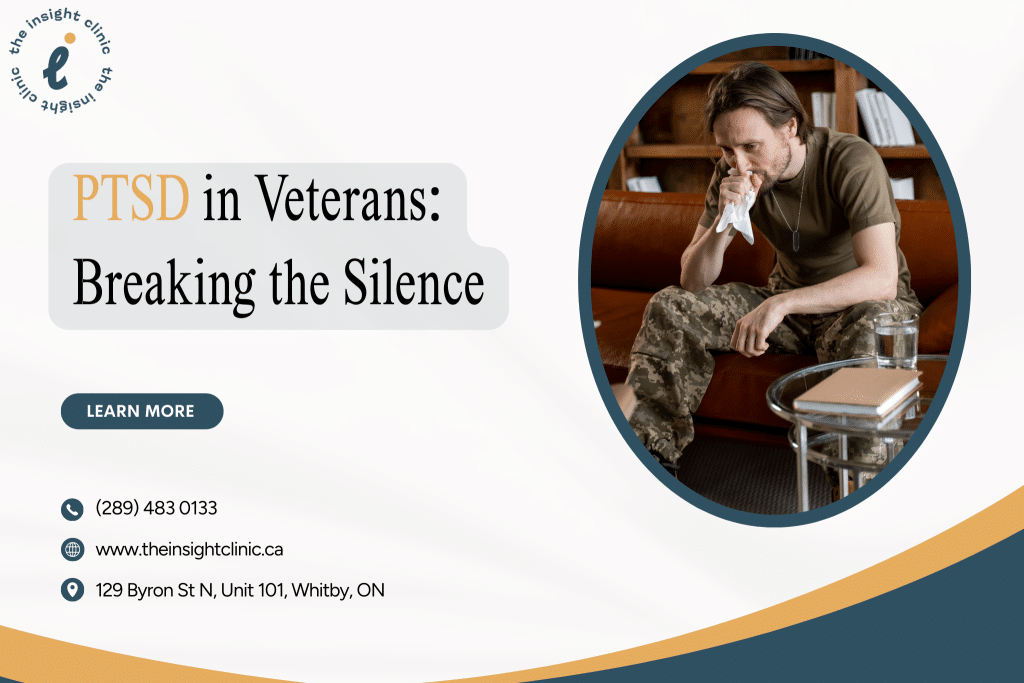
When the Battle Doesn’t End at Home
For many veterans, the end of service does not mean the end of survival mode.
The schedule changes. The uniform is gone. Civilian life resumes.
But internally, something still feels activated.
You may notice:
- Tension that never fully leaves your body
- Irritability that surprises even you
- Sleep that feels shallow or disrupted
- A sense of emotional distance from people you care about
Post-Traumatic Stress Disorder (PTSD) does not always look dramatic. Sometimes it looks like functioning — but exhausted. Capable — but disconnected.
For veterans and families in Durham Region and Whitby, Ontario, one of the hardest parts is not knowing whether what you’re experiencing is normal adjustment… or something more.
At The Insight Clinic (TIC), many veterans begin with the same quiet thought:
“I should be fine by now.”
This article is here to gently challenge that belief and offer clarity around Trauma and PTSD, the Signs and Symptoms of PTSD, and what ethical, trauma-informed PTSD Treatment in Ontario actually looks like.
What Is Post-Traumatic Stress Disorder?
Post-Traumatic Stress Disorder is a trauma-related mental health condition that develops when the nervous system remains stuck in threat-response mode after overwhelming experiences.
From a clinical perspective, PTSD affects:
- Memory processing
- Threat detection systems
- Emotional regulation
- Sleep cycles
- Cognitive flexibility
But from a lived perspective, it feels like:
- Your body reacts before your mind can reason
- You scan environments automatically
- You feel detached from emotions — or overwhelmed by them
In military environments, these responses are adaptive. Hypervigilance can save lives. Emotional suppression can allow you to function under pressure.
The challenge arises when those same adaptations persist in safe environments.
PTSD is not a disorder of character.
It is a nervous system that has not yet recalibrated.
In Psychotherapy for PTSD at The Insight Clinic, one of the first goals is helping the body relearn safety — not through force, but through gradual regulation.
How PTSD Affects the Brain and Body
Understanding what happens neurologically in Post-Traumatic Stress Disorder can be relieving for many veterans.
PTSD is not just psychological — it is biological.
Research shows that Trauma and PTSD can affect:
- The amygdala (threat detection system)
- The hippocampus (memory integration)
- The prefrontal cortex (decision-making and impulse regulation)
- Stress hormone regulation, including cortisol and adrenaline
When the amygdala becomes overactive, it scans constantly for danger — even in safe environments. This explains why a slammed door can trigger a surge of adrenaline before your mind registers that you are home.
The hippocampus, responsible for organizing memory, may struggle to place traumatic events firmly in the past. As a result, memories can feel current rather than historical.
Meanwhile, the prefrontal cortex — the rational part of the brain — may temporarily lose its ability to “override” the alarm system.
This is why logic alone rarely resolves PTSD symptoms.
At The Insight Clinic, Psychotherapy for PTSD often begins by explaining this physiology. When veterans understand that their reactions are rooted in neurobiology — not weakness — shame begins to decrease.
Regulation becomes possible when self-blame decreases.
Trauma and PTSD in Military Service
Military trauma is rarely one single event.
It can be:
- Repeated exposure to danger
- Chronic anticipation of threat
- Witnessing loss
- Moral injury (actions or events that conflict with personal values)
- Military sexual trauma
- Prolonged operational stress
- Sudden identity loss after discharge
Sometimes the trauma is what happened.
Sometimes it is what didn’t happen — support, validation, protection.
One of the complexities of Trauma and PTSD in veterans is that symptoms may not surface immediately. They can emerge during:
- Career transitions
- Retirement
- Parenting
- Injury recovery
- Relationship changes
At The Insight Clinic, we often explore not just the trauma itself, but the meaning attached to it. Moral injury, in particular, requires space for processing guilt, shame, and identity disruption — not just fear-based symptoms.
Moral Injury: When the Wound Is Ethical, Not Physical
One aspect of Trauma and PTSD in veterans that is often overlooked is moral injury.
Moral injury occurs when actions — or inactions — violate deeply held values. It may involve:
- Witnessing events that conflict with personal beliefs
- Feeling responsible for outcomes beyond your control
- Experiencing betrayal by leadership or institutions
- Surviving when others did not
Unlike fear-based trauma, moral injury is often rooted in guilt, shame, or identity disruption.
Veterans struggling with moral injury may not describe flashbacks. Instead, they may say:
“I can’t forgive myself.”
“I don’t recognize who I was.”
“I don’t feel worthy of moving forward.”
Standard stress-management tools alone are not enough for moral injury. It requires space for meaning-making.
At The Insight Clinic, trauma-informed PTSD Treatment Ontario includes helping veterans process ethical wounds — not just nervous system activation.
Healing in these cases often involves rebuilding identity, reconnecting with personal values, and restoring a sense of integrity.
What Are the Signs and Symptoms of PTSD?
The Signs and Symptoms of PTSD exist across four major domains:
1. Intrusion
- Flashbacks
- Nightmares
- Sudden emotional flooding
- Physical reactions to reminders
These experiences are not “memories” in the traditional sense. They are nervous system activations.
2. Avoidance
- Avoiding crowds
- Avoiding media related to service
- Avoiding conversations
- Emotional numbing
Avoidance protects — but over time, it narrows life.
3. Negative Changes in Mood and Thinking
- Persistent guilt or shame
- Feeling detached from others
- Loss of interest
- Difficulty experiencing positive emotions
Many veterans describe this as feeling “flat” or “not like myself anymore.”
4. Hyperarousal
- Irritability
- Startle response
- Sleep disruption
- Concentration difficulty
- Constant scanning
Hyperarousal is exhausting. It keeps the body in a stress cycle that affects cardiovascular health, digestion, and mood regulation.
At The Insight Clinic, treatment begins with stabilizing these stress responses before deeper trauma processing occurs.
Clinical Note: Diagnosis of Post-Traumatic Stress Disorder requires formal assessment by a qualified professional through a psychiatric or psychological assessment.
The Hidden Costs of Untreated PTSD
When Post-Traumatic Stress Disorder goes untreated, its impact can extend beyond emotional distress.
Chronic hyperarousal places strain on:
- Cardiovascular health
- Digestive functioning
- Immune response
- Sleep architecture
Over time, veterans may experience increased risk of:
- Hypertension
- Chronic fatigue
- Substance misuse
- Social withdrawal
- Occupational burnout
Sometimes the cost is subtle — turning down promotions, avoiding gatherings, withdrawing from hobbies.
Avoidance can slowly shrink life.
At The Insight Clinic, early intervention through Psychotherapy for PTSD aims not only to reduce symptoms but to protect long-term health and relational stability.
PTSD Treatment Ontario is not just about crisis management. It is about restoring quality of life.
Barriers to “Breaking the Silence”
Understanding the Barriers to “Breaking the Silence” requires understanding military culture.
Strength is prized. Self-reliance is expected. Endurance is normalized.
Asking for help can feel like betraying those values.
Other barriers include:
- Fear of being misunderstood by civilian providers
- Concern about confidentiality
- Belief that others experienced “worse”
- Distrust shaped by trauma
- Difficulty finding specialized PTSD Treatment Ontario
At The Insight Clinic, trauma-informed care means:
- You are not pressured to share before you’re ready
- You are not analyzed without collaboration
- You are not reduced to a diagnosis
Silence is understandable.
But isolation prolongs nervous system dysregulation.
Breaking the silence often begins not with disclosure — but with education.
What to Expect in a First Therapy Session
Uncertainty keeps many veterans from booking a first appointment.
Common concerns include:
- “Will I be asked to relive everything immediately?”
- “Will I lose control of the conversation?”
- “Will the therapist understand military culture?”
At The Insight Clinic, a first session for Psychotherapy for PTSD is structured and collaborative.
It typically includes:
- Clarifying goals
- Exploring current symptoms
- Reviewing relevant history at a comfortable pace
- Discussing treatment options
- Answering questions about confidentiality
There is no forced disclosure. No expectation to recount traumatic events in detail.
The first session focuses on safety and understanding — not exposure.
Many veterans leave their first appointment saying:
“That felt more practical than I expected.”
How PTSD Impacts Relationships and Families
PTSD reshapes relational patterns.
Partners may experience:
- Emotional withdrawal
- Heightened conflict
- Misinterpretation of irritability
- Feeling like they are “walking on eggshells”
Children may sense tension without understanding its source.
Family members sometimes internalize symptoms — believing they caused the emotional distance.
At The Insight Clinic, we often integrate:
Overthinking or Feeling Stressed?
Gain insight into anxiety-related thoughts and emotional responses.
- Couple-based support
- Parent consultation
- Psychoeducation about Trauma and PTSD
- Communication skill-building
When families understand what hyperarousal or avoidance actually means neurologically, blame decreases — and empathy increases.
What Is Ethical PTSD Treatment in Ontario?
Ethical PTSD Treatment Ontario prioritizes safety, pacing, and informed consent.
Trauma processing is never forced.
Effective treatment may include:
- Emotional regulation training
- Grounding techniques
- Cognitive restructuring
- Trauma-focused approaches
- Gradual exposure
- Identity rebuilding
In Psychotherapy for PTSD at The Insight Clinic, treatment often unfolds in phases:
Phase 1: Stabilization
Learning how to calm the nervous system.
Phase 2: Processing
Carefully integrating traumatic memories when appropriate.
Phase 3: Reconnection
Rebuilding identity, values, and relationships.
Treatment is collaborative. Clients maintain autonomy at every stage.
Many veterans find relief simply in understanding that their reactions make physiological sense.
Here is the revised EMDR section, now more clearly integrating The Insight Clinic, while remaining ethical, compliant, and SEO-strong:
EMDR for PTSD: A Structured Approach to Trauma Processing
One evidence-based approach sometimes used in the treatment of Post-Traumatic Stress Disorder is Eye Movement Desensitization and Reprocessing (EMDR).
EMDR is a structured psychotherapy method designed to help the brain reprocess traumatic memories so they feel less emotionally intense and less physiologically activating. Unlike traditional talk therapy, EMDR does not require detailed verbal retelling of traumatic events. Instead, it uses bilateral stimulation — such as guided eye movements or tapping — while the client briefly focuses on specific memories.
The goal is not to erase the memory.
The goal is to help the brain store it as something that happened in the past, rather than something that feels like it is happening in the present.
For veterans experiencing Trauma and PTSD, EMDR may be considered when:
- Intrusive memories remain highly distressing
- Certain events feel “stuck” or unresolved
- Emotional reactions feel disproportionate to current situations
- Avoidance patterns are limiting daily functioning
At The Insight Clinic in Durham Region and Whitby, EMDR is offered as part of a broader, trauma-informed approach to PTSD Treatment in Ontario. It is not used in isolation or introduced abruptly. Before trauma processing begins, clinicians prioritize stabilization — building grounding skills, strengthening emotional regulation, and ensuring the client feels adequately resourced.
EMDR is not appropriate for everyone at every stage. Decisions about using EMDR are collaborative and based on readiness, symptom presentation, and overall stability. Ethical Psychotherapy for PTSD always emphasizes pacing, informed consent, and client autonomy.
Many veterans appreciate that EMDR is structured and protocol-driven. Sessions follow a clear framework, which can feel predictable and contained — qualities that often align well with military training and preferences for clarity.
When integrated thoughtfully within trauma-informed care at The Insight Clinic, EMDR can support the reduction of distress associated with traumatic memories and help promote long-term integration.
Why Choose Local PTSD Treatment in Ontario?
Accessing local PTSD Treatment in Ontario in Durham Region and Whitby provides:
- Reduced travel burden
- Greater consistency
- Integration with local healthcare providers
- Family participation options
At The Insight Clinic, services supporting Post-Traumatic Stress Disorder may include:
- Individual trauma-informed psychotherapy
- Art therapy for non-verbal trauma processing
- Family and couple sessions
- Psychoeducational assessments when clinically indicated
- Collaborative care planning
Each intervention is grounded in regulation, empowerment, and clinical ethics.
The Role of Identity After Service
For many veterans, Post-Traumatic Stress Disorder is intertwined with identity loss.
Military service often provides:
- Structure
- Brotherhood and sisterhood
- Clear hierarchy
- Defined purpose
- Predictable expectations
Transitioning into civilian life can feel disorienting — even without Trauma and PTSD.
When PTSD symptoms are present, that transition becomes even more complex.
Questions often arise:
Who am I outside of service?
Where do I belong?
How do I translate my skills?
At The Insight Clinic, PTSD Treatment Ontario may include exploring identity reconstruction.
Reconnection is not just about symptom reduction. It is about helping veterans integrate service experiences into a broader, evolving sense of self.
When Should a Veteran Seek Support?
Consider professional support if:
- Symptoms last longer than one month
- Relationships are deteriorating
- Work performance declines
- Substance use increases
- Emotional numbness persists
- Anger feels disproportionate
- Sleep disturbance becomes chronic
You do not need to wait until crisis.
Early intervention often prevents symptoms from becoming entrenched.
Supporting a Veteran with PTSD
If you are supporting someone with Post-Traumatic Stress Disorder:
Focus on consistency rather than solutions.
Helpful statements include:
- “I’m here.”
- “You don’t have to explain everything.”
- “Would it help to talk to someone together?”
Avoid minimizing or personalizing symptoms.
Caregivers often benefit from their own support space. At The Insight Clinic, we provide guidance for partners navigating the emotional complexity of living alongside Trauma and PTSD.
Recovery Is Not Linear
One of the most important realities about Psychotherapy for PTSD is that progress is rarely a straight line.
There may be:
- Periods of relief
- Temporary increases in emotional awareness
- Breakthrough moments
- Setbacks triggered by anniversaries or life stressors
This does not mean treatment is failing.
It means the nervous system is recalibrating.
At The Insight Clinic, trauma-informed care emphasizes pacing and resilience-building so that temporary setbacks do not derail progress.
Veterans often report that the most powerful shift is not the absence of triggers — but the confidence that they can manage them.
That shift restores agency.
Building a Personalized PTSD Treatment Plan
No two veterans experience Post-Traumatic Stress Disorder in exactly the same way. That’s why effective PTSD Treatment Ontario is never one-size-fits-all.
Some veterans primarily struggle with hyperarousal — irritability, sleep disruption, constant vigilance. Others are more affected by avoidance, emotional numbness, or moral injury. Some may also experience anxiety, depression, or substance use alongside Trauma and PTSD.
A personalized treatment plan considers:
- Symptom profile
- Trauma history
- Current stressors
- Physical health
- Family dynamics
- Readiness for trauma processing
- Personal goals for recovery
At The Insight Clinic, Psychotherapy for PTSD begins with collaborative treatment planning. Together, we identify what feels most urgent:
Is it improving sleep?
Reducing anger outbursts?
Rebuilding connection with a partner?
Processing a specific traumatic memory?
Treatment may integrate regulation work, cognitive strategies, trauma-focused approaches, and relational support — all paced according to client readiness.
Personalization matters because healing is not only about symptom reduction. It is about restoring stability, meaning, and autonomy.
When veterans participate actively in shaping their treatment plan, engagement increases — and so does progress.
PTSD may shape part of your story, but it does not have to define the entire trajectory.
Conclusion: Compassion, Regulation, and Reconnection
Post-Traumatic Stress Disorder is not about weakness.
It is about survival patterns that outlast danger.
With ethical, trauma-informed Psychotherapy for PTSD, many veterans experience:
- Reduced hypervigilance
- Improved sleep
- Greater emotional range
- Stronger relational connection
- Renewed sense of identity
For veterans and families in Durham Region and Whitby, Ontario, PTSD Treatment Ontario is available locally through The Insight Clinic. If you are unsure whether what you’re experiencing qualifies as Post-Traumatic Stress Disorder, a consultation can provide clarity without obligation.
Breaking the silence does not require telling every detail. Sometimes it begins simply by allowing someone to sit beside you. If you’d like to learn more call us or book a free 15 min. consultation.
Frequently Asked Questions About PTSD in Veterans
What is Post-Traumatic Stress Disorder (PTSD) in veterans?
Post-Traumatic Stress Disorder (PTSD) is a trauma-related mental health condition that can develop after exposure to combat, military sexual trauma, moral injury, or other overwhelming events during service. In veterans, PTSD may affect memory processing, emotional regulation, sleep, and threat detection, causing symptoms such as hypervigilance, avoidance, irritability, and intrusive memories.
What are the common signs and symptoms of PTSD in veterans?
Common Signs and Symptoms of PTSD include flashbacks, nightmares, emotional numbness, avoidance of reminders, irritability, sleep disturbance, exaggerated startle response, and difficulty concentrating. Symptoms must persist for more than one month and cause significant distress or impairment to meet diagnostic criteria for Post-Traumatic Stress Disorder.
How is PTSD different from normal adjustment after service?
Transition stress after military service is common. PTSD differs when symptoms are persistent, intense, and interfere with daily functioning, relationships, or work. If hypervigilance, avoidance, or emotional disconnection continue beyond the initial adjustment period, an assessment for Post-Traumatic Stress Disorder may be appropriate.
What is moral injury, and how is it related to PTSD?
Moral injury refers to psychological distress resulting from actions — or lack of actions — that conflict with deeply held values. While not identical to Post-Traumatic Stress Disorder, moral injury often overlaps with Trauma and PTSD. It may involve guilt, shame, or identity disruption rather than fear-based symptoms alone.
What types of PTSD treatment are available in Ontario?
PTSD Treatment in Ontario may include trauma-informed psychotherapy, EMDR (Eye Movement Desensitization and Reprocessing), cognitive-based approaches, emotional regulation training, and family support. Treatment plans are individualized based on symptom profile, readiness, and personal goals.
Is EMDR effective for PTSD in veterans?
EMDR is an evidence-based therapy commonly used in the treatment of Post-Traumatic Stress Disorder. It helps reprocess traumatic memories so they feel less emotionally activating. EMDR is typically introduced after stabilization work and is used as part of a broader trauma-informed treatment plan.
How long does psychotherapy for PTSD take?
The length of Psychotherapy for PTSD varies depending on symptom severity, trauma complexity, and treatment goals. Some veterans benefit from short-term structured therapy, while others engage in longer-term work focused on identity reconstruction and relational healing.
When should a veteran seek professional help for PTSD?
Veterans should consider seeking support if symptoms last longer than one month, interfere with work or relationships, increase substance use, disrupt sleep, or lead to emotional withdrawal. Early intervention can reduce the long-term impact of Post-Traumatic Stress Disorder.
Can family members participate in PTSD treatment?
Yes. Trauma and PTSD often affect the entire family system. Family sessions, couple-based support, and psychoeducation can help reduce misunderstanding and strengthen communication. In Durham Region and Whitby, trauma-informed services may include family involvement when clinically appropriate.
Where can veterans access PTSD treatment in Durham Region or Whitby?
Veterans in Durham Region and Whitby can access trauma-informed PTSD Treatment Ontario through regulated mental health professionals. At The Insight Clinic, services may include Psychotherapy for PTSD, EMDR, family support, and collaborative care planning within an ethical and client-centered framework.

Clinical Review by Gretchen Savery
Gretchen Savery, Registered Psychotherapist (Qualifying), supports The Insight Clinic’s blog review and approval process by helping ensure content is accurate, thoughtful, and aligned with professional standards, including CRPO expectations around ethical communication, client confidentiality, and responsible mental health education. Her role helps strengthen the quality, clarity, and trustworthiness of the clinic’s educational resources.

Blog Writer Bio — Dr. Betsy Bautista
Dr. Betsy Bautista is an experienced medical doctor and mental health counsellor contributing educational content for The Insight Clinic. With a strong background in supporting adults and seniors, she brings clinical insight, compassion, and a deep understanding of emotional health, aging, grief, chronic illness, family relationships, anxiety, depression, and life transitions. Her writing helps make complex mental health topics easier to understand while supporting The Insight Clinic’s commitment to thoughtful, accessible, and evidence-informed education.