Table of Contents
- When Your Child Is Not Speaking, Connection Can Still Grow
- How Nonverbal Children Communicate in Everyday Life
- Can Art and Music Therapy Help a Nonverbal Child Communicate?
- How Music-Based Activities May Support Communication and Regulation
- How Art-Based Activities May Support Expression in Nonverbal Children
- Why Communication Support Often Works Best When It Goes Beyond Speech
- How Art and Music Can Support Social Connection
- Therapy Options for Nonverbal Children in Ontario
- How Art and Music Therapy Can Work Alongside ABA Therapy, Psychotherapy, and Parent Coaching
- Why Regulation Matters Before Communication
- What Parents Can Do at Home to Support a Nonverbal Child
- What Parents May Want to Avoid
- How to Choose the Right Support for Your Child in Whitby or Durham Region
- When Might It Be Time to Seek Support?
- Support for Families in Whitby and Durham Region
- A Gentle Next Step for Families Looking for Support
- Frequently Asked Questions About Therapy for Nonverbal Children
When Your Child Is Not Speaking, Connection Can Still Grow
If your child is not speaking, it is natural to have questions.
You may be wondering how to better understand their needs, how to support communication, or whether the right kind of therapy could help them feel more connected and understood. For many families, this can feel confusing at first, especially when traditional communication advice does not seem to fit their child.
What matters most is this: communication does not begin and end with spoken words.
Many nonverbal children communicate through movement, facial expressions, gestures, sounds, behaviour, play, routines, and sensory responses. The goal is not to force speech before a child is ready. The goal is to notice how your child already communicates and build from there.
For some families, art and music therapy for nonverbal children can be helpful ways to support that process. These approaches may create opportunities for expression, shared attention, emotional connection, and communication without placing pressure on a child to speak.
In this article, you will learn:
- what “nonverbal” can mean in daily life
- how art and music therapy may support communication
- how these approaches can work alongside other supports
- what parents can try at home
- what to consider when looking for therapy options in Ontario
How Nonverbal Children Communicate in Everyday Life
When parents hear the word nonverbal, it can sound absolute, but children communicate in many ways beyond speech.
A child who is nonverbal may:
- point, reach, or pull an adult toward something
- use facial expressions or body language
- make sounds or vocalizations
- communicate through behaviour or routines
- respond through movement, play, rhythm, or sensory preferences
For some children, limited spoken language may be associated with developmental, communication, sensory, emotional, or neurodivergent differences. For others, speech may emerge gradually over time or remain limited while other forms of communication become stronger.
What matters is not assuming that a child has nothing to say. It is recognizing that communication may look different and supporting it in ways that feel accessible and safe.
What parents often notice
In everyday life, parents may see:
- frustration when needs are not understood
- meltdowns or shutdowns during stressful moments
- difficulty participating in social interactions
- limited spoken words or inconsistent verbal communication
- avoidance when there is pressure to respond verbally
This is one reason many families begin looking into therapy options for nonverbal children. They are not only looking for speech. They are often looking for ways to help their child feel more connected, regulated, understood, and able to express themselves.
Can Art and Music Therapy Help a Nonverbal Child Communicate?
In many cases, they may be helpful as part of a broader support plan.
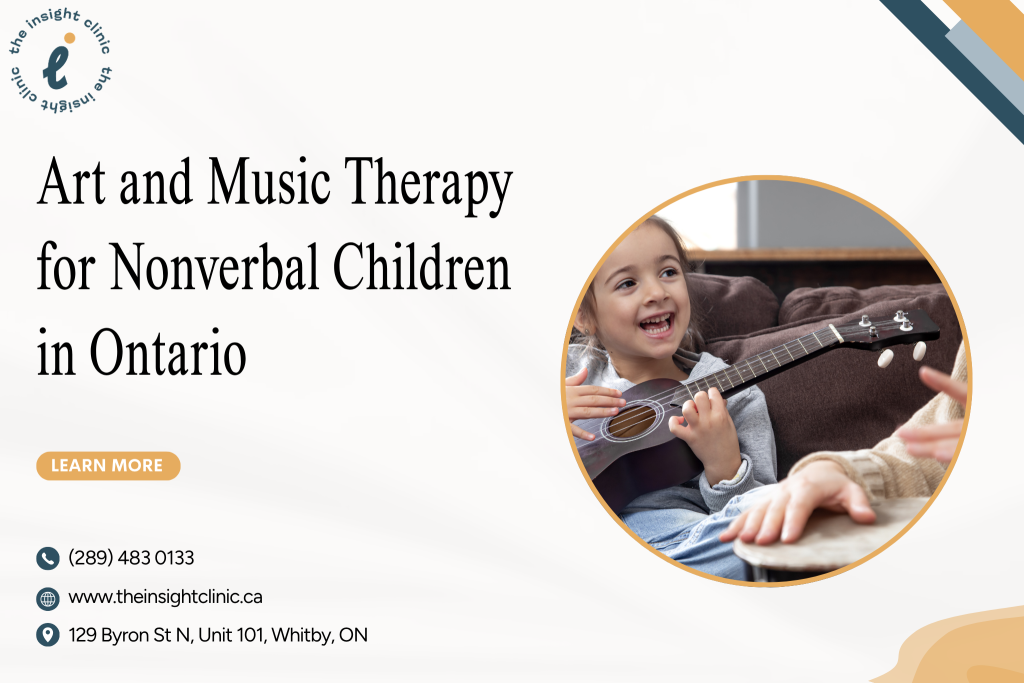
Art and music therapy for nonverbal children focuses on communication in a wider sense. Instead of expecting a child to express everything through spoken language, these approaches may support interaction through shared activities, creativity, sensory engagement, rhythm, play, and emotional expression.
For some children, this can reduce the pressure that often comes with direct verbal demands.
A child may not be ready to answer questions, label feelings, or follow a language-heavy interaction. But they may be able to:
- tap a rhythm back and forth
- choose an instrument
- draw with intention
- communicate preferences through colour, movement, or repetition
- participate in a shared activity with another person
These moments may seem small from the outside, but they can be important building blocks for communication.
How Music-Based Activities May Support Communication and Regulation
Music offers structure, repetition, and sensory input all at once. For many children, that can make interaction feel more predictable and less demanding.
In music therapy for nonverbal children, communication may be supported through:
- rhythm and turn-taking
- shared attention during songs or instrument play
- vocal play and sound imitation
- movement paired with music
- predictable routines that help a child feel safer in interaction
A therapist might use musical repetition to encourage anticipation, pause for the child to respond in their own way, or build back-and-forth engagement without requiring words.
For example, a child may:
- reach for a drum when they want more
- smile or look toward the therapist at a familiar pause
- imitate a beat or sound
- use movement to show excitement, interest, or preference
These are all forms of communication.
For some children, music can support regulation first. Once a child feels calmer, safer, and more engaged, communication may become easier.
How Art-Based Activities May Support Expression in Nonverbal Children
Art can offer another pathway for communication, especially for children who respond well to visual, sensory, or tactile experiences.
Art therapy for nonverbal children may support:
- emotional expression
- choice-making
- sensory exploration
- shared focus with a therapist
- confidence through creative participation
A child may not be able to explain how they feel in words, but they may communicate a great deal through the way they approach materials, repeat certain colours or patterns, avoid or seek certain textures, or respond to a shared creative activity.
Art can also support communication by giving the child more control. They are not being asked to perform language. They are being invited to participate, express, and interact at their own pace.
For some children, this can lower frustration and increase willingness to engage.
Why Communication Support Often Works Best When It Goes Beyond Speech
One of the most important ideas for parents to hear is this:
A child does not need to be speaking in full sentences to be communicating.
Communication can include:
- eye gaze
- gestures
- body movement
- facial expression
- sound-making
- symbolic play
- choosing between options
- shared attention with another person
When support focuses only on speech, children may miss opportunities to strengthen these other forms of communication first.
When communication is recognized more broadly, families often begin to notice progress they may not have seen before. A child who begins seeking interaction, tolerating shared activities, showing clearer preferences, or participating more consistently may already be making meaningful gains in communication.
How Art and Music Can Support Social Connection
Parents often worry not only about communication, but also about social connection.
Will my child be able to relate to others?
Will they want to play with peers?
How do social skills develop if talking is limited?
Creative therapies can sometimes support early social development because they do not depend entirely on conversation.
Through shared art and music activities, children may begin to:
- tolerate being near another person during an activity
- build joint attention
- copy actions or sounds
- participate in turn-taking
- show anticipation during familiar interactions
- gradually increase comfort in a shared space
This kind of progress may look subtle at first.
A child might glance at the therapist during a song, wait for a repeated part, hand over a material, imitate a movement, or stay engaged in parallel play longer than before. These moments may be early signs of increasing social participation.
For nonverbal children, connection often develops through experience before it develops through spoken conversation.
Therapy Options for Nonverbal Children in Ontario
Families often look at more than one kind of support when they are trying to help a child who is not yet speaking or who communicates in nonverbal ways.
Depending on the child’s needs, therapy options may include art therapy, music therapy, psychotherapy, ABA therapy, parent training and coaching, psychoeducational assessment, psychiatrist assessment, or a combination of services that support communication, regulation, behaviour, and family stress together.
Some families at The Insight Clinic in Whitby use art therapy or music therapy alongside services such as psychotherapy, ABA therapy, parent training and coaching, assessments, tutoring, or creative programs, depending on what their child needs.
That kind of multidisciplinary approach can be especially helpful when a child has needs across communication, emotional regulation, behaviour, learning, and daily routines.
How Art and Music Therapy Can Work Alongside ABA Therapy, Psychotherapy, and Parent Coaching
Parents are often told about several different services, but it is not always clear how those supports relate to one another.
Wondering How Healthy Your Relationship Feels?
Gain clarity around trust, intimacy, and communication.
For some children, art and music therapy may help create opportunities for expression, engagement, and shared attention. ABA therapy may be used to support communication goals, routines, and skill-building in a more structured way. Psychotherapy may be helpful when emotional regulation, anxiety, or family stress are also part of the picture. Parent training and coaching can help caregivers understand how to respond to communication attempts and support progress at home.
A child’s support plan at The Insight Clinic may include services like art therapy, music therapy, ABA therapy, psychotherapy, parent training and coaching, or assessments. In some situations, families later add creative art classes or tutoring as goals begin to include learning, participation, or confidence.
Why Regulation Matters Before Communication
Many children communicate more effectively when they feel regulated.
If a child is overwhelmed by sensory input, anxious in unfamiliar settings, or frustrated by demands they cannot yet meet, communication may become even harder. This is one reason creative and sensory-friendly therapies can be helpful for some children.
Music, movement, rhythm, and art materials may support:
- calming and settling
- body awareness
- sensory engagement
- emotional expression
- increased readiness for interaction
This does not mean every child responds the same way. Some children love sound but dislike messy art materials. Others enjoy drawing but avoid music-based activities. A thoughtful, child-centered approach takes those preferences seriously.
The goal is not to make a child fit the activity. The goal is to find forms of interaction that fit the child.
What Parents Can Do at Home to Support a Nonverbal Child
Parents do not need to recreate therapy sessions at home. Small, consistent interactions can still support communication in meaningful ways.
You can:
- use simple music during routines to add predictability
- offer drawing or creative materials without pressure
- follow your child’s lead in play
- respond to gestures, sounds, and movement as valid communication
- reduce repeated demands to “say it” before your child is ready
If parents are unsure how to apply these strategies consistently, parent training and coaching can sometimes help. At The Insight Clinic, parent training and coaching is one way families may learn how to better support communication, emotional regulation, and day-to-day routines between sessions.
This can be especially useful when parents are trying to balance communication needs with behaviour, school stress, sibling dynamics, or sensory overwhelm at home.
1. Use music during routines
Simple songs can create predictability and connection during transitions, clean-up, bedtime, bath time, or getting ready to leave the house.
You can:
- repeat familiar songs
- pause and wait to see how your child responds
- add gestures or movements
- notice whether certain rhythms or sounds help your child feel calmer
2. Offer art without pressure
Provide simple materials and let your child explore.
You might:
- offer crayons, markers, chalk, paint, or textured materials
- allow free expression without correcting
- notice how your child communicates preferences
- join the activity without taking over
The focus does not need to be on making something good. The focus can be on participation, shared attention, and expression.
3. Follow your child’s lead in play
If your child is spinning, tapping, lining things up, drawing, humming, or repeating an action, try joining gently rather than redirecting immediately.
This can help build:
- trust
- shared attention
- turn-taking
- back-and-forth engagement
4. Reduce pressure to speak
Many well-meaning adults ask a child to “say it,” “use your words,” or repeat sounds on demand. In some situations, this may increase frustration rather than helping.
A more supportive approach may be to:
- acknowledge the child’s attempt to communicate
- model simple language without pressure
- respond to gestures, sounds, or choices
- make communication feel successful
What Parents May Want to Avoid
When trying to support a nonverbal child, families often need reassurance about what not to do as much as what to do.
It may help to avoid:
- forcing speech
- over-correcting during play or creative activities
- giving too many verbal instructions at once
- assuming a child is not understanding because they are not speaking
- focusing only on what is absent instead of noticing what is already working
Connection usually grows more easily when a child feels understood rather than tested.
How to Choose the Right Support for Your Child in Whitby or Durham Region
When parents begin looking for support, the options can feel overwhelming. The most helpful starting point is not usually finding the perfect therapy right away. It is finding a thoughtful, child-centered approach that takes your child’s communication style seriously.
It may help to ask:
- Does this provider recognize communication beyond speech?
- Is the approach flexible and developmentally appropriate?
- Are parents included in the process?
- Can the clinic offer more than one kind of support if needs change over time?
For families in Whitby and Durham Region, a multidisciplinary clinic can make that process easier. At The Insight Clinic, families may be able to explore different services. That can be helpful when communication differences overlap with emotional, behavioural, academic, or developmental concerns.
A broad service model also makes it easier to adjust support as the child grows.
When Might It Be Time to Seek Support?
Some parents wonder whether they should wait and see. Others worry they are overreacting.
It may be worth exploring support if:
- your child seems frequently frustrated when trying to communicate
- you are seeing repeated distress, withdrawal, or difficulty connecting
- communication challenges are affecting daily routines or family stress
- you want help understanding which supports may fit your child’s needs
Seeking support does not mean something is wrong with your child. It may simply mean you want more guidance, more structure, or a better understanding of how to support communication in a way that fits your child.
Support for Families in Whitby and Durham Region
If you are looking for support for a nonverbal child in Whitby or the Durham Region, it may help to choose a setting where communication, regulation, behaviour, and family needs can all be looked at together.
At The Insight Clinic, the type of support a family uses can vary over time. Some children benefit from one focused service, while others may need a more integrated approach.
For example, one family may begin with parent coaching and psychotherapy, while another may need ABA therapy alongside art or music therapy, assessment, or academic support. The right fit depends on the child’s profile, goals, and stage of development.
A Gentle Next Step for Families Looking for Support
If your child is not speaking, or if communication feels especially difficult right now, it may be helpful to talk things through with someone who can look at the bigger picture.
At The Insight Clinic in Whitby, families may be trying to understand many different pieces at once, including communication, regulation, behaviour, learning, or day-to-day stress at home. In that kind of situation, it can be helpful to start by considering what kind of support might fit the child and family best.
You do not need to decide everything right away. Sometimes the most useful first step is simply talking through what you have been seeing and what options may make sense from there.
Frequently Asked Questions About Therapy for Nonverbal Children
1. Can art and music therapy help nonverbal children communicate?
They may support communication by creating opportunities for expression, shared attention, emotional connection, and interaction without relying only on spoken language.
2. What is the difference between art therapy and music therapy?
Art therapy uses visual and creative materials such as drawing, painting, or tactile expression. Music therapy uses rhythm, sound, repetition, and movement. Both may support communication and emotional expression in different ways.
3. How can I help a nonverbal child communicate at home?
Parents can support communication by following the child’s lead, using music in routines, offering art as a form of expression, responding to gestures and sounds, and reducing pressure to speak.
4. Are art and music therapy only for children with autism?
No. These approaches may be explored by children with a range of communication, emotional, sensory, or developmental needs. The fit depends on the child, not only on a diagnosis.
5. What therapy options are available for nonverbal children in Ontario?
Some families explore art therapy, music therapy, play therapy, ABA therapy, psychotherapy, parent coaching, and assessment services depending on the child’s needs and goals.
6. How do I know if a therapy program is a good fit?
Look for an approach that is child-centered, respectful of nonverbal communication, flexible, and clear about how it supports both the child and family.
7. Does a nonverbal child need speech to make progress?
Not necessarily. Progress may include stronger engagement, clearer communication through gestures or behaviour, improved regulation, increased shared attention, and more consistent interaction.
8. Where can families find support in Whitby or Durham Region?
Families in Whitby and the Durham Region may look for multidisciplinary clinics that offer child and family support services, including art therapy, music therapy, psychotherapy, ABA therapy, parent coaching, assessments, and creative programs.

Clinical Review by Gretchen Savery
Gretchen Savery, Registered Psychotherapist (Qualifying), supports The Insight Clinic’s blog review and approval process by helping ensure content is accurate, thoughtful, and aligned with professional standards, including CRPO expectations around ethical communication, client confidentiality, and responsible mental health education. Her role helps strengthen the quality, clarity, and trustworthiness of the clinic’s educational resources.

Blog Writer Bio — Dr. Betsy Bautista
Dr. Betsy Bautista is an experienced medical doctor and mental health counsellor contributing educational content for The Insight Clinic. With a strong background in supporting adults and seniors, she brings clinical insight, compassion, and a deep understanding of emotional health, aging, grief, chronic illness, family relationships, anxiety, depression, and life transitions. Her writing helps make complex mental health topics easier to understand while supporting The Insight Clinic’s commitment to thoughtful, accessible, and evidence-informed education.