Table of Contents
- When You Are Trying to Make Sense of New Autism Therapy Options
- What Are VR and AR in Autism Therapy?
- How VR May Be Used in Autism Therapy
- Potential Benefits of AR in Autism Support
- Why Technology Should Not Replace Individualized Care
- How Autism Therapy May Be Combined in a Broader Plan
- Autism Therapy for Different Ages and Goals
- ABA Therapy in Ontario: Home vs Clinic
- Sensory Regulation and the Safe and Sound Protocol
- What Families in Whitby and Durham Region Are Often Looking For
- Small Steps Parents Can Take This Week
- You Do Not Have to Sort Through Every Option Alone
- FAQs About VR and AR Autism Therapy in Ontario
When You Are Trying to Make Sense of New Autism Therapy Options
If you are a parent looking into autism therapy options in Ontario, it is easy to feel pulled in many directions.
You may already be hearing about supports like ABA therapy, psychotherapy, sensory-based approaches, or neurofeedback. Now, more families are also coming across terms like virtual reality (VR) and augmented reality (AR) in conversations about autism care.
That can raise a lot of understandable questions.
Is this something that could actually help my child?
Is it meant for younger children, teens, or adults?
Is it a replacement for more established therapies, or something used alongside them?
These are important questions, especially for families in Whitby, Durham Region, and across Ontario who are trying to choose support that feels both practical and appropriate.
The short answer is that VR and AR are not stand-alone solutions. In some cases, they may be used as tools within a broader therapy plan to support learning, practice, engagement, or skill development. What matters most is not the technology itself, but whether the approach fits the individual’s needs, goals, sensory profile, and stage of development.
This article explains what VR and AR autism therapy in Ontario may look like, where these tools may be helpful, and why they are best understood as part of a personalized, clinically thoughtful plan rather than a one-size-fits-all answer.
What Are VR and AR in Autism Therapy?
Virtual reality
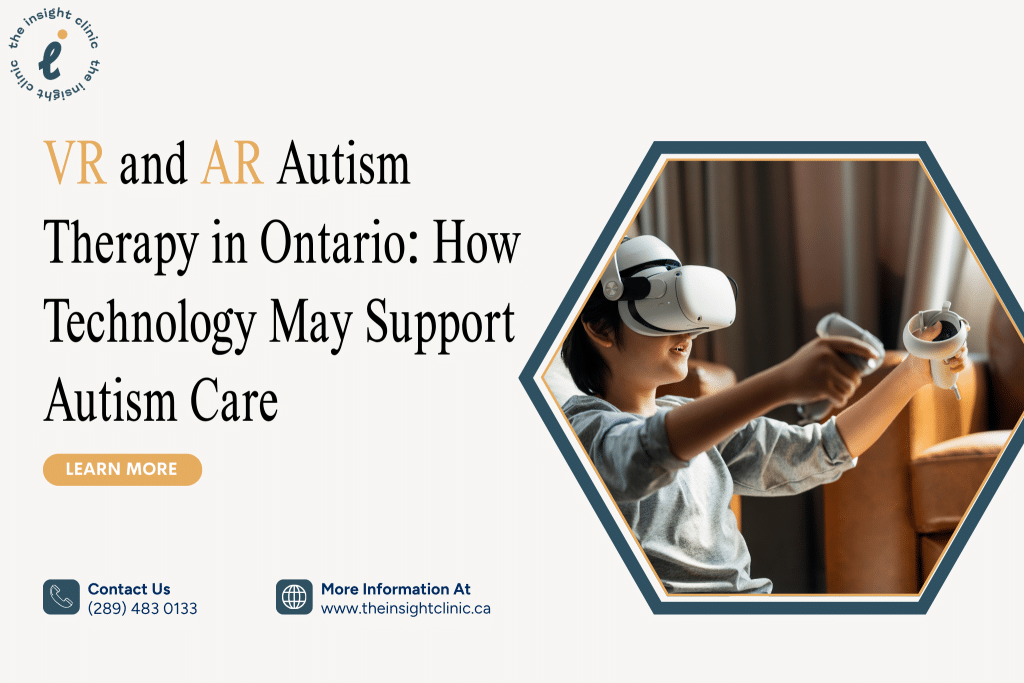
Virtual reality creates a computer-generated environment that a person can interact with in a more immersive way. In therapy-related settings, that might mean practicing everyday situations in a structured digital space.
For example, a child or teen might be guided through a simulated classroom, store, waiting room, or social situation where they can rehearse a skill with support.
Augmented reality
Augmented reality works differently. Instead of placing the person inside a fully virtual setting, AR adds prompts, visuals, or interactive elements into the real environment.
This might include step-by-step visual support, interactive cues, or learning prompts layered onto a real-world task.
Why families are hearing more about these tools
Families across Ontario are increasingly looking for autism therapy approaches that are:
- personalized
- engaging
- adaptable to different learning styles
- supportive of real-life goals
Technology-based tools are getting more attention because they may offer structured, repeatable ways to practice certain tasks. That said, they are not automatically the right fit for every child, and they should not be presented as a replacement for relationship-based, individualized care.
How VR May Be Used in Autism Therapy
Virtual reality autism therapy in Ontario is still an emerging area, but interest has grown because VR may allow therapists to create structured practice opportunities in a more controlled setting.
Depending on the child or teen, VR-based activities may be used to support goals such as:
- practicing unfamiliar routines
- preparing for community situations
- working on emotional recognition
- building comfort with new environments
- rehearsing aspects of social interaction
A child, for instance, might practice entering a classroom, approaching a peer, or moving through a public setting with guidance. For some individuals, the benefit is not that the experience is “better” than real life, but that it may feel more predictable and easier to repeat in a gradual way.
What VR therapy may look like in practice
In a guided setting, VR-based work might involve:
- rehearsing greetings or conversation starters
- practicing transitions between environments
- exploring sensory or social situations with support
- learning coping strategies before facing a real-world version of the same task
For some children, that structure may help reduce uncertainty. For others, the sensory load of VR may not feel comfortable or appropriate. This is one reason why technology should always be matched to the individual rather than assumed to be helpful by default.
Is virtual reality effective for autism treatment?
The more accurate answer is that VR may be helpful for some individuals and for some goals, especially when used thoughtfully and alongside broader therapeutic support.
It should not be described as a universal autism treatment or as something that works the same way for every person. Autism is highly individual, and response to any therapy tool can vary based on age, communication profile, sensory needs, tolerance for technology, and the specific goals being addressed.
Potential Benefits of AR in Autism Support
Augmented reality tends to be easier to picture once you think about real-life tasks.
Instead of entering a fully virtual world, the child remains in the actual environment while digital prompts or visual supports help guide attention, sequence, or learning.
AR tools for autism support may be used to assist with:
- visual schedules
- step-by-step routines
- task completion
- transitions
- learning prompts in daily environments
For example, an AR-supported task might help a child move through a sequence like washing hands, packing a bag, or completing a classroom routine with more visual guidance.
Why AR may be useful for some children
Some children benefit from visual structure that helps make a task feel clearer and more manageable. AR may support this by:
- reducing reliance on verbal instruction alone
- making routines easier to follow
- reinforcing learning in the moment
- helping bridge practice from therapy into daily life
Like any tool, though, AR is not automatically useful just because it is interactive. For some children, simple low-tech visual supports may be just as effective. The goal is not to make therapy more high-tech for its own sake, but to choose supports that genuinely fit the child.
How AR is different from VR
The distinction is simple:
VR creates a simulated environment.
AR adds support to the real environment.
Both can be explored in autism intervention contexts, but they are used differently and may serve different kinds of goals.
Why Technology Should Not Replace Individualized Care
It is easy for newer tools to sound exciting, especially when families are looking for progress and practical support. But technology alone is not therapy.
Children and teens usually benefit most from interventions that are:
- individualized
- developmentally appropriate
- guided by clear goals
- adjusted as needs change
- grounded in human connection
That means VR or AR should be seen as possible tools within a plan, not as the plan itself.
For some families, the most useful next step is not a technology-based intervention at all. It may be parent training and coaching, psychotherapy, ABA therapy, an assessment, emotional regulation support, academic support, or a combination of services that better fits the current picture.
How Autism Therapy May Be Combined in a Broader Plan
In many cases, families are not choosing between one approach and another in a strict way. Instead, they are trying to understand which supports may work well together.
At The Insight Clinic in Whitby, care may be built around the person’s profile rather than around a single therapy model. Depending on the individual, that may include services such as ABA therapy, psychotherapy, neurofeedback, creative therapies, parent training and coaching, or assessment-based guidance.
Technology-based tools may sometimes complement broader work by helping support:
- practice opportunities
- structured learning
- engagement with a task
- generalization into daily routines
The key point is that the overall therapy plan should remain focused on the person’s goals, functioning, comfort, and capacity rather than on using a particular tool because it is new or popular.
Autism Therapy for Different Ages and Goals
One reason families can feel unsure is that autism support needs often change over time.
Difficulty Concentrating or Staying Organized?
Gain insight into attention challenges and explore supportive next steps.
What helps a young child may not be the same as what supports a teenager. The goals for an adult may be different again.
Young children
For younger children, support may focus on areas such as:
- communication
- play
- flexibility
- sensory regulation
- early daily living skills
At this stage, therapy often works best when it feels developmentally appropriate, engaging, and connected to everyday routines.
School-age children
For school-age children, common goals may include:
- transitions
- classroom-related routines
- emotional regulation
- peer interaction
- independence with daily tasks
This is often where visual supports, structured practice, or skill-building approaches may become especially useful.
Teens
For teens, therapy may shift more toward:
- social understanding
- self-awareness
- coping strategies
- confidence in unfamiliar settings
- increasing independence
Adults
For adults, goals may vary widely and may include:
- emotional regulation
- executive functioning
- confidence in daily routines
- social communication
- support around work, study, or community participation
A good therapy plan should reflect not only age, but also the individual’s communication style, sensory profile, preferences, and current life demands.
ABA Therapy in Ontario: Home vs Clinic
Families exploring autism therapy options in Ontario also often ask whether ABA therapy should happen at home or in a clinic setting.
The answer depends on the goals.
Home-based ABA therapy
Home-based sessions may be helpful when the focus is on:
- routines
- transitions
- self-care tasks
- family-based strategies
- skills that need to be practiced in the natural environment
Clinic-based ABA therapy
Clinic-based sessions may be helpful when the focus is on:
- structured teaching
- minimizing distractions
- access to specific materials
- certain social or group opportunities
For some families, a mix of settings may make sense. What matters most is not choosing the “best” setting in the abstract, but choosing the setting that best supports the goals being worked on.
Sensory Regulation and the Safe and Sound Protocol
Some families also explore supports related to sensory regulation, especially when a child seems easily overwhelmed, reactive, or persistently dysregulated.
The Safe and Sound Protocol is a listening-based intervention that some clinicians may use as part of a broader regulation-focused plan. It is often discussed in relation to sensory processing, emotional regulation, and nervous system support.
The safest way to describe it is that it may be considered for some individuals depending on their needs and clinical presentation. It should not be framed as a guaranteed solution or as something that is appropriate for everyone.
When sensory regulation is a major concern, it is usually most helpful to look at the full picture:
- what situations are difficult
- what patterns keep showing up
- what the child seems to need in those moments
- which supports are realistic at home, school, and in therapy
What Families in Whitby and Durham Region Are Often Looking For
Families in Whitby and throughout Durham Region are often searching for more than a single therapy label. They are usually trying to answer questions like:
What kind of support actually matches my child right now?
What can help at home and at school?
Do we need one service or a combination?
How do we make this feel manageable?
In practice, families are often looking for:
- clear guidance
- local access to support
- realistic next steps
- care that can adjust over time
- a plan that takes the whole child and family into account
That is often more useful than chasing the newest therapy trend on its own.
Small Steps Parents Can Take This Week
When new therapy options start showing up online, it can be tempting to compare everything at once. A more grounded approach is to step back and focus on your child’s current needs.
Notice patterns
Pay attention to where your child seems to struggle most right now. For example:
- transitions
- sensory overwhelm
- unfamiliar environments
- communication during stress
- social uncertainty
- daily living routines
Clarify the goal before the method
Before asking whether VR, AR, ABA, neurofeedback, or another support is the “right” one, ask:
- What specific skill or challenge are we trying to address?
- What setting is this showing up in most?
- What level of support does my child tolerate well?
Ask practical questions in a consultation
Questions like these are often more useful than asking for the “best” therapy:
- What are the main goals you would prioritize first?
- Which supports are most appropriate for my child’s age and profile?
- How will progress be reviewed?
- How do you decide whether a tool or approach is actually helping?
You Do Not Have to Sort Through Every Option Alone
Trying to understand autism therapy options can feel overwhelming, especially when newer approaches are being talked about alongside more established supports.
The most helpful next step is usually not choosing the newest option first. It is getting clearer on your child’s needs, your family’s priorities, and which supports may be appropriate right now.
At The Insight Clinic in Whitby, families may explore a range of services depending on the individual’s goals, including ABA therapy, psychotherapy, neurofeedback, parent training and coaching, assessments, and creative supports for neurotypical and neurodivergent children, teens, and adults. When appropriate, care can be shaped around communication, regulation, behaviour, learning, and everyday functioning.
Reaching out does not mean committing to a single path right away. Sometimes the first step is simply having a conversation that helps you understand what kinds of support may make the most sense from here.
FAQs About VR and AR Autism Therapy in Ontario
1. Is virtual reality effective for autism treatment?
Virtual reality may be helpful for some individuals and some goals, particularly when used as part of a broader therapy plan. It should not be seen as a one-size-fits-all treatment.
2. What is the difference between VR and AR in autism therapy?
VR creates an immersive digital environment, while AR adds prompts or interactive elements to the real world. They are used differently depending on the goal.
3. Can VR therapy help children with autism practice real-life situations?
In some cases, yes. It may be used to rehearse situations such as transitions, community settings, or aspects of social interaction in a more structured way.
4. What are AR tools used for in autism support?
AR tools may be used for visual prompts, routines, step-by-step task guidance, and other supports that help make daily activities easier to follow.
5. Is VR or AR a replacement for ABA therapy or psychotherapy?
No. These tools are better understood as possible supports within a broader treatment plan rather than replacements for individualized clinical care.
6. Is home-based or clinic-based ABA therapy better in Ontario?
Neither setting is universally better. The best choice depends on the child’s goals, environment, and the kinds of skills being targeted.
7. Can autism therapy plans change with age?
Yes. Therapy goals often shift over time as children grow and as daily demands, developmental needs, and independence goals change.
8. How do I know which autism therapy approach may fit my child?
A good starting point is a thoughtful assessment of strengths, challenges, goals, and daily functioning. From there, support can be tailored more realistically.

Clinical Review by Gretchen Savery
Gretchen Savery, Registered Psychotherapist (Qualifying), supports The Insight Clinic’s blog review and approval process by helping ensure content is accurate, thoughtful, and aligned with professional standards, including CRPO expectations around ethical communication, client confidentiality, and responsible mental health education. Her role helps strengthen the quality, clarity, and trustworthiness of the clinic’s educational resources.

Blog Writer Bio — Dr. Betsy Bautista
Dr. Betsy Bautista is an experienced medical doctor and mental health counsellor contributing educational content for The Insight Clinic. With a strong background in supporting adults and seniors, she brings clinical insight, compassion, and a deep understanding of emotional health, aging, grief, chronic illness, family relationships, anxiety, depression, and life transitions. Her writing helps make complex mental health topics easier to understand while supporting The Insight Clinic’s commitment to thoughtful, accessible, and evidence-informed education.