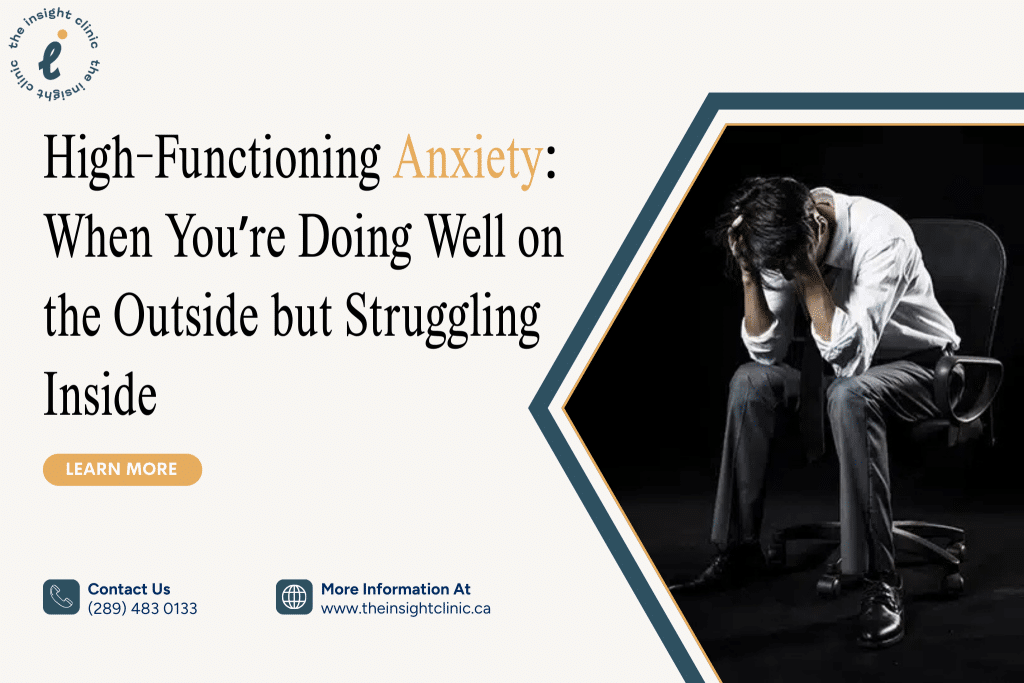
Do You Appear Calm on the Outside While Anxiety Runs the Show Inside?
You get things done.
You show up prepared.
Others rely on you.
And yet, anxiety hums quietly in the background of your life.
For many people, anxiety doesn’t look like panic attacks or emotional breakdowns. Instead, it hides behind productivity, reliability, and constant self-monitoring. This experience is often described as high-functioning anxiety, a pattern commonly seen in clients seeking counselling at Mental Health Clinics across Ontario, including The Insight Clinic in Whitby and Durham Region.
High-functioning anxiety keeps you moving, but it rarely lets you rest. Over time, the nervous system stays activated, leading to ongoing anxiety symptoms that affect both mental and physical health.
What Does High-Functioning Anxiety Actually Feel Like Day to Day?
High-functioning anxiety often feels like:
- A brain that never fully shuts off
- A body that’s tense even during “downtime”
- Guilt when resting
- Pressure to perform, even when no one is asking
People with this form of anxiety are often described as capable or successful, yet internally feel on edge. At clinics like The Insight Clinic in Whitby, many clients are surprised to learn that these experiences are recognized anxiety patterns—not personality flaws.
Understanding anxiety in this way helps shift the focus from “What’s wrong with me?” to “What is my nervous system trying to protect me from?”
How Can Anxiety Exist Without Panic Attacks or Obvious Distress?
Anxiety doesn’t always announce itself loudly.
Common anxiety symptoms include:
- Muscle tension and jaw clenching
- Headaches or stomach discomfort
- Difficulty sleeping despite exhaustion
- Constant anticipation of what could go wrong
These physical anxiety symptoms often bring people into counselling before they even realize anxiety is the root cause. In many cases, at The Insight Clinic approaches like somatic therapies or Neurofeedback Therapy for Anxiety are especially helpful because they address how anxiety lives in the body and brain—not just in thoughts.
How Does High-Functioning Anxiety Look Different in Children and Teens?
High-functioning anxiety doesn’t begin in adulthood for many people. It often starts quietly in childhood or adolescence.
In children, high-functioning anxiety may show up as:
- Being exceptionally well-behaved or overly responsible
- Strong people-pleasing and fear of disappointing adults
- Closely following rules and avoiding conflict
- Holding anxiety together at school, then melting down at home
Teachers may describe these children as “no trouble at all,” even though they are managing intense internal anxiety symptoms throughout the day.
In teens, high-functioning anxiety often appears as:
- Academic pressure and perfectionism
- Fear of disappointing parents, teachers, or peers
- Relentless self-criticism despite strong performance
- Private struggles with sleep, constant worry, or social anxiety
Many teens with high-functioning anxiety achieve good grades, participate in extracurriculars, and appear motivated—while feeling chronically overwhelmed inside.
At a Mental Health Clinic in Ontario like The Insight Clinic in Whitby, clinicians frequently support children and teens whose anxiety has gone unnoticed precisely because they are functioning so well on the surface, using developmentally appropriate counselling, regulation-focused therapies, and parent training and coaching to address what’s happening beneath the behaviour.
Why Is High-Functioning Anxiety Often Missed in School Settings?
Schools are typically designed to notice externalized challenges—disruptions, defiance, or academic decline. High-functioning anxiety, however, hides behind compliance and achievement.
Students with high-functioning anxiety may:
- Over-prepare for assignments
- Become distressed over minor mistakes
- Avoid asking for help out of fear of appearing incapable
- Experience physical anxiety symptoms before tests or presentations
Because these students continue to perform, their anxiety symptoms may go unnoticed until burnout, emotional exhaustion, or school refusal emerges.
This is why early counselling and regulation-focused therapies—such as somatic therapies or Neurofeedback Therapy for Anxiety—can be especially protective for children and teens who internalize stress rather than express it outwardly.
How Does High-Functioning Anxiety Affect Teen Identity and Self-Worth?
Adolescence is a time of identity formation, and high-functioning anxiety can quietly shape how teens see themselves.
Many teens begin to associate their worth with performance, productivity, or approval. High-functioning anxiety reinforces the belief that rest must be earned and mistakes are unacceptable. Over time, this can contribute to chronic anxiety symptoms, low self-compassion, and social anxiety.
In counselling at The Insight Clinic, teens often discover that their anxiety is not a reflection of who they are—but a learned survival strategy. Therapy focuses on helping teens separate identity from achievement and develop a sense of self that isn’t dependent on constant striving.
What Is Social Anxiety Disorder and How Does It Show Up in High-Functioning People?
What is Social Anxiety Disorder?
It’s a persistent fear of judgment, embarrassment, or being misunderstood in social or performance situations.
Many high-functioning individuals meet criteria for social anxiety while continuing to work, parent, and socialize—often at great emotional cost. They may rehearse conversations, overanalyze interactions, or feel drained after social events.
In counselling, understanding what Social Anxiety Disorder actually is can be deeply relieving. It reframes the experience from “I’m bad at people” to “My anxiety system is overprotective.”
Why Do Social Situations Feel So Exhausting Even When You Handle Them Well?
Social anxiety activates the brain’s threat system.
Eye contact, silence, or perceived judgment can trigger anxiety symptoms like:
- Rapid heart rate
- Mental blanking
- Excessive self-criticism
At The Insight Clinic, clients with social anxiety often benefit from combining counselling with somatic therapies or Neurofeedback Therapy for Anxiety, which help calm the nervous system so social interactions no longer feel like survival situations.
Why Is It Hard to Ask for Help When You’re Still “Functioning”?
One of the most overlooked aspects of anxiety is how often it goes untreated because the person is still performing.
Many clients hesitate to seek counselling or psychiatrist consultation because they feel they should be coping better—or worry they’ll be dismissed. But anxiety does not need to reach crisis levels to deserve care.
At our Mental Health Clinic in Ontario, early support often prevents burnout, depression, or physical health issues linked to chronic anxiety.
How Can You Begin Managing Anxiety Without Pushing Yourself Harder?
Anxiety doesn’t improve through willpower alone.
Helpful first steps often include:
- Increasing awareness of anxiety symptoms
- Learning grounding techniques
- Reducing self-imposed pressure
- Exploring therapies that support regulation, not just insight
This is why many clinicians integrate counselling with somatic therapies, helping clients notice how anxiety shows up physically and respond with safety rather than self-criticism.
How Do Somatic Therapies Help Calm Anxiety in the Body?
Somatic therapies focus on the nervous system rather than just thoughts.
They help:
- Reduce chronic tension
- Improve breathing patterns
- Increase awareness of safety cues
For people with long-standing anxiety or social anxiety, somatic therapies can feel more accessible than traditional talk therapy alone. These approaches are often integrated into anxiety treatment plans at clinics like The Insight Clinic in Whitby, especially when anxiety symptoms are body-driven.
When Is Neurofeedback Therapy Helpful for High-Functioning Anxiety in Youth?
Children and teens with high-functioning anxiety often describe feeling “wired,” restless, or unable to shut their brain off—especially at night.
Neurofeedback Therapy for Anxiety can be particularly helpful for young people who:
- Overthink constantly
- Struggle with sleep due to racing thoughts
- Feel emotionally overwhelmed despite appearing calm
- Have difficulty relaxing even during downtime
By supporting the brain’s ability to self-regulate, Neurofeedback may help reduce baseline anxiety symptoms and make counselling strategies easier to use in daily life.
At The Insight Clinic in Whitby, Neurofeedback is often integrated thoughtfully alongside counselling for youth with high-functioning anxiety.
What Makes Neurofeedback Therapy for Anxiety Different From Talk Therapy?
Neurofeedback Therapy for Anxiety works directly with brain activity.
Instead of analyzing anxiety, neurofeedback helps the brain learn healthier regulation patterns. This may help reduce:
- Hypervigilance
- Emotional reactivity
- Persistent anxiety symptoms
Clients who feel their anxiety is “automatic” or hard to control often find Neurofeedback particularly supportive—especially when combined with counselling for emotional insight.
When Is a Psychiatrist Consultation Helpful for Anxiety?
A psychiatrist consultation can be useful when:
- Anxiety symptoms are severe or long-standing
- Sleep, work, or relationships are affected
- Medication is being considered
At multidisciplinary clinics, psychiatrist consultation is typically collaborative—working alongside counselling, somatic therapies, or Neurofeedback Therapy for Anxiety rather than replacing them.
How Does Counselling Support Long-Term Anxiety Management?
Counselling helps people understand:
- Where anxiety came from
- How patterns developed
- What maintains anxiety today
In counselling for anxiety, therapists at our clinic often address perfectionism, people-pleasing, and fear-based self-worth. For social anxiety, counselling helps clients understand what Social Anxiety Disorder looks like in their own lives and develop strategies that feel realistic and compassionate.
Overthinking or Feeling Stressed?
Gain insight into anxiety-related thoughts and emotional responses.
Why Does Perfectionism So Often Go Hand-in-Hand With Anxiety?
Perfectionism is often anxiety’s coping strategy, not a fixed personality trait. For people with high-functioning anxiety, it can serve as a way to manage fear and maintain a sense of control.
Perfectionism is commonly driven by:
- Fear of making mistakes or being judged
- Fear of rejection or disappointing others
- Belief that safety or self-worth depends on performance
- Attempt to reduce uncertainty by controlling outcomes
While perfectionism may initially support achievement, it often keeps anxiety active by reinforcing constant self-monitoring and self-criticism.
Through counselling, clients learn to:
- Distinguish healthy motivation from anxiety-based pressure
- Recognize when striving is driven by fear rather than values
- Loosen unrealistic standards without lowering expectations
- Maintain competence and ambition while reducing internal strain
This shift allows people to pursue goals with more flexibility and less anxiety—without losing what matters to them.
Why Is Rest So Difficult When You Live With Anxiety?
For people with high-functioning anxiety, rest often feels uncomfortable rather than restorative. Anxiety trains the nervous system to stay alert, productive, and responsive—even when rest is needed.
Anxiety can make rest feel:
- Unsafe, as if something important might be missed
- Unproductive or undeserved unless it is “earned”
- Anxiety-provoking, with racing thoughts surfacing when activity stops
- Tied to guilt, especially for those who value responsibility and achievement
Many clients in counselling at The Insight Clinic discover that they haven’t learned how to rest without self-criticism. Instead, rest may trigger anxiety symptoms rather than relieve them.
As part of anxiety treatment, rest is reframed:
- Not as indulgence, but as nervous system regulation
- Not as stopping completely, but as allowing recovery
- Not as weakness, but as a skill that can be practiced and learned
With support, people can begin to experience rest as something that supports well-being rather than something that must be justified.
How Can Parents Support a Child or Teen With High-Functioning Anxiety Without Increasing Pressure?
Parents of children with high-functioning anxiety often feel stuck. Their child appears capable, yet is clearly distressed internally.
Common challenges include:
- Knowing when to encourage and when to slow things down
- Managing reassurance-seeking without reinforcing anxiety
- Supporting achievement without increasing pressure
At The Insight Clinic, parent support is often integrated into anxiety treatment. Parents learn how to respond to anxiety symptoms in ways that promote nervous system safety, emotional resilience, and autonomy—rather than unintentionally maintaining high-functioning anxiety patterns.
How Can You Rebuild Trust in Yourself After Years of Anxiety?
Chronic anxiety—especially high-functioning anxiety—often erodes self-trust over time. When anxiety is constantly consulted, people begin to second-guess their instincts, decisions, and internal signals.
Rebuilding trust often involves learning to:
- Notice bodily signals without immediately overriding them
- Differentiate intuition from anxiety-driven fear
- Respect boundaries around energy, time, and emotional capacity
- Make choices based on safety and values rather than avoidance or pressure
For many people, self-doubt develops not because they lack insight, but because anxiety has been directing decisions for too long.
Through counselling and regulation-focused therapies, this process unfolds gradually. As anxiety softens, individuals can practice responding to themselves with consistency and care—allowing trust to rebuild without needing anxiety to be in control.
How Does High-Functioning Anxiety Carry Into Adulthood If Left Untreated?
When high-functioning anxiety goes unaddressed in childhood or adolescence, it often continues into adulthood.
Adults may:
- Tie self-worth to productivity
- Struggle with work-life balance
- Experience chronic physical anxiety symptoms
- Develop social anxiety or burnout
This continuity is why early intervention matters. A Mental Health Clinic in Ontario that supports anxiety across the lifespan—like The Insight Clinic—can help individuals and families interrupt these patterns before they become deeply ingrained.
Is It Really Possible to Feel Better Even If You’re “Doing Fine”?
Yes — and this question matters more than most people realize.
High-functioning anxiety often convinces you that help is only for people who are falling apart. If you’re still working, parenting, studying, or showing up, it can feel like your anxiety “doesn’t count.” But functioning is not the same as feeling okay.
For people with high-functioning anxiety, “doing fine” usually means:
- Holding yourself together through constant internal pressure
- Staying productive while your nervous system never fully rests
- Managing anxiety symptoms privately so others don’t notice
- Believing you should be grateful instead of exhausted
Over time, this creates a quiet kind of burnout — not because you can’t cope, but because coping has become your full-time job.
Feeling better doesn’t require collapse. It requires a shift in permission.
- Permission to stop waiting for things to get worse
- Permission to name anxiety even when life looks successful
- Permission to want more than survival and self-control
At The Insight Clinic in Whitby, many people begin support at this exact point — not in crisis, but in fatigue. Through counselling, somatic therapies, and approaches like Neurofeedback Therapy for Anxiety, they learn that anxiety can ease without losing their competence, identity, or drive.
Getting better doesn’t mean becoming less capable. It means:
- Carrying less internal tension
- Letting your nervous system stand down
- Experiencing rest without guilt
- Feeling calm without constantly earning it
High-functioning anxiety is still anxiety. And it is treatable — even if you’ve been “doing fine” for a very long time.
Why Is a Multidisciplinary Approach Especially Important for High-Functioning Anxiety?
High-functioning anxiety affects the mind, body, and brain.
At The Insight Clinic, support may include:
- Counselling to address cognitive and emotional patterns
- Somatic therapies to support nervous system regulation
- Neurofeedback Therapy for Anxiety to improve brain flexibility
- Psychiatrist consultation when anxiety symptoms significantly impact daily functioning
This integrated approach acknowledges that high-functioning anxiety is not just a thinking problem—it’s a whole-system experience.
What Does Healing Look Like for Someone With High-Functioning Anxiety?
Healing from high-functioning anxiety doesn’t mean losing motivation, ambition, or care for others.
It means:
- Feeling safe enough to rest
- Letting go of constant self-monitoring
- Experiencing achievement without fear
- Connecting socially without exhaustion
Whether you’re an adult, a teen, or a parent supporting a child, meaningful change is possible when anxiety is understood—not judged—and supported with the right tools.
What Support Is Available for Anxiety in Whitby and Ontario?
At The Insight Clinic, anxiety care is individualized and integrative. As a Mental Health Clinic in Ontario, serving Whitby and Durham Region, TIC supports anxiety through:
- Counselling
- Somatic therapies
- Neurofeedback Therapy for Anxiety
- Psychiatrist consultation when appropriate
This approach recognizes that anxiety affects the mind, body, and brain—and improvement often happens when all three are supported together.
What If the Next Step Isn’t “Fixing” Anxiety, But Feeling Safe Again?
High-functioning anxiety doesn’t mean you’re broken.
It means your nervous system has been carrying more than it should—quietly, consistently, and often alone.
If you see yourself or your child in this article, support doesn’t have to wait until things fall apart. Many people reach out when they’re tired of managing anxiety privately, even though life looks “fine” on the outside.
At The Insight Clinic, we support children, teens, and adults living with high-functioning anxiety through a thoughtful, integrative approach. This may include counselling, somatic therapies, Neurofeedback Therapy for Anxiety, parent training and coaching and psychiatrist consultation when appropriate—always guided by your needs, pace, and goals.
Reaching out doesn’t mean you’re giving up control. It means you’re choosing support instead of carrying everything alone.
If you’re ready to explore what feeling calmer, more grounded, and less pressured could look like, our team in Whitby, Durham Region and across Ontario is here to help you take that next step—gently, collaboratively, and without judgment. You’re welcome to reach out to learn more about our services or request an Initial Consultation.
Frequently Asked Questions About High-Functioning Anxiety
What is high-functioning anxiety?
High-functioning anxiety describes a pattern where someone appears capable, reliable, and productive on the outside while experiencing ongoing anxiety internally. It often involves constant self-monitoring, difficulty resting, and persistent anxiety symptoms despite outward success.
Can you have anxiety without panic attacks?
Yes. Anxiety does not always involve panic attacks or visible distress. Many people experience anxiety through physical tension, racing thoughts, sleep difficulties, or constant worry, even when they appear calm and functional.
What are common anxiety symptoms in high-functioning anxiety?
Common anxiety symptoms include chronic muscle tension, jaw clenching, headaches, digestive discomfort, difficulty sleeping despite exhaustion, and a persistent sense that something could go wrong, even when life appears stable.
How does high-functioning anxiety show up in children and teens?
In children, high-functioning anxiety may appear as being overly responsible, eager to please, or exceptionally well-behaved, with emotional release happening at home. In teens, it often shows up as perfectionism, academic pressure, fear of disappointing others, or social anxiety.
Why is high-functioning anxiety often missed in school settings?
High-functioning anxiety is frequently missed because students continue to perform well academically and follow rules. Their anxiety symptoms may remain unnoticed until burnout, emotional exhaustion, or school avoidance begins to emerge.
What is Social Anxiety Disorder, and how does it relate to high-functioning anxiety?
Social Anxiety Disorder involves a persistent fear of judgment or embarrassment in social or performance situations. Many people with high-functioning anxiety experience social anxiety while continuing to function at work, school, or home, often at significant emotional cost.
What types of therapy are used to support high-functioning anxiety?
Support may include counselling, somatic therapies that focus on nervous system regulation, Neurofeedback Therapy for Anxiety, and psychiatrist consultation when appropriate. These approaches address anxiety as a whole-system experience involving the mind, body, and brain.
Is high-functioning anxiety treatable?
Yes. High-functioning anxiety is still anxiety and can be supported with appropriate care. Many people seek help not because they are in crisis, but because they are tired of managing anxiety privately while appearing “fine” on the outside.

Clinical Review by Gretchen Savery
Gretchen Savery, Registered Psychotherapist (Qualifying), supports The Insight Clinic’s blog review and approval process by helping ensure content is accurate, thoughtful, and aligned with professional standards, including CRPO expectations around ethical communication, client confidentiality, and responsible mental health education. Her role helps strengthen the quality, clarity, and trustworthiness of the clinic’s educational resources.

Blog Writer Bio — Dr. Betsy Bautista
Dr. Betsy Bautista is an experienced medical doctor and mental health counsellor contributing educational content for The Insight Clinic. With a strong background in supporting adults and seniors, she brings clinical insight, compassion, and a deep understanding of emotional health, aging, grief, chronic illness, family relationships, anxiety, depression, and life transitions. Her writing helps make complex mental health topics easier to understand while supporting The Insight Clinic’s commitment to thoughtful, accessible, and evidence-informed education.