Table of Contents
- Introduction: What If You Could Call “The Zone” on Demand?
- What Exactly Is Neurofeedback Therapy, and Why Do Performers Use It?
- What Does “Peak Performance” Mean in Brain Terms?
- How Do Brainwaves Relate to Focus, Precision, and Flow?
- Isn’t Some Stress Helpful? (The Yerkes–Dodson Law)
- What Are the Most Common Peak-Performance Protocols?
- What Does a Typical Peak-Performance Session Look Like?
- How Is Training Personalized? (qEEG and Role-Specific Targets)
- How Do You Know It’s Working? (Metrics That Matter)
- What Benefits Should I Expect, Near Term vs Long Term?
- How Does Neurofeedback Compare With Other Performance Tools?
- Is Neurofeedback Safe? Are There Side Effects?
- What About At-Home Training, Does It Work?
- What Does a Smart 8–12 Week Peak-Performance Plan Look Like?
- Real-World Use Cases, What Changes Do People Notice?
- How Can You Maintain Neurofeedback Results Over Time?
- What About Brain, Computer Interfaces (BCIs) and the Future?
- How Do I Choose a Qualified Provider?
- Conclusion: From Practice to Performance: Keep the Gains
Introduction: What If You Could Call “The Zone” on Demand?
Imagine surpassing your personal best, on the field, in the OR, at the piano, or in a high-stakes meeting, while still having energy left for family, hobbies, and a good night’s sleep. That smooth, hyper-present state so many pros describe, “the zone” or flow, isn’t just luck. It’s a reproducible brain state.
Neurofeedback therapy is a way to train your nervous system to access that state more reliably. Using real-time EEG feedback, it nudges your brain toward patterns linked to calm focus, precision, and adaptability. With repetition, your brain learns to stay there longer and to return faster after stress or distraction. This article unpacks how it works, who benefits, and how to build a practical training plan.
What Exactly Is Neurofeedback Therapy, and Why Do Performers Use It?
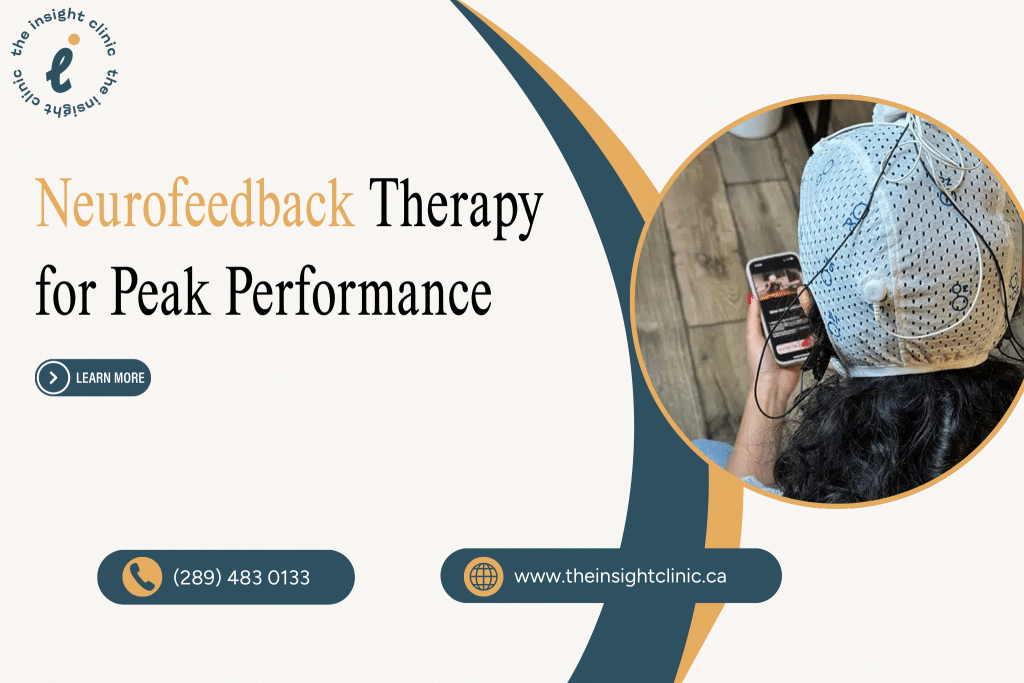
Neurofeedback is a specialized form of biofeedback that mirrors your brain’s electrical activity back to you so it can learn to self-correct. Sensors placed on the scalp record brainwaves (no electricity is sent into the brain). Software translates those waves into feedback, like a movie that brightens when your brain is in the target state and dims when it drifts.
Over many short sessions, the nervous system is rewarded each time it enters the desirable pattern, calm but alert, steady yet flexible. Your brain becomes more efficient the same way a pianist’s fingers or a striker’s footwork become automatic with practice. That’s why elite athletes, surgeons, musicians, pilots, traders, esports players, and executives all use neurofeedback: it builds consistency under pressure.
What Does “Peak Performance” Mean in Brain Terms?
Peak performance isn’t about intensity alone, it’s about optimal arousal and neural efficiency:
- Too little arousal → sluggish, distracted, under-engaged.
- Too much arousal → rigid, tense, error-prone.
- Optimal arousal → focused, fluid, accurate—flow.
EEG patterns tied to this sweet spot usually show adequate alpha (relaxed clarity), stable low-beta/SMR (quiet body, steady attention), and limited high-beta (tension). Neurofeedback trains your brain to spend more time in those patterns and transition faster between them as context changes.
How Do Brainwaves Relate to Focus, Precision, and Flow?
Your brain produces a symphony of rhythms; different sections lead depending on the task:
- Delta (0.5–3 Hz): deep sleep and recovery.
- Theta (4–8 Hz): creativity, insight, “autopilot.”
- Alpha (9–14 Hz): relaxed alertness; sensory filtering; fluid timing.
- SMR / Low-Beta (12–15 Hz): calm focus; still body; precise control.
- Mid-Beta (15–20 Hz): task engagement, planning.
- High-Beta (20–30 Hz): urgency; can help in short bursts but degrades performance when chronically elevated.
- Gamma (30+ Hz): rapid integration; binding of sensory inputs.
Flow often features a balanced alpha–SMR mix: you’re alert but not over-amped, physically settled, and mentally present. Neurofeedback helps stabilize that mix and curb counterproductive spikes (e.g., high-beta jitters before a free throw).
Isn’t Some Stress Helpful? (The Yerkes–Dodson Law)
Yes. A century of performance science shows a U-shaped relationship between arousal and performance. A little stress sharpens focus; too much stress hijacks precision and memory. Neurofeedback teaches arousal control, so you can dial up intensity for a sprint or a speech, then dial it down to recover quickly and protect decision quality.
What Are the Most Common Peak-Performance Protocols?
There’s no one-size-fits-all. The best programs start with a brief assessment (often a resting EEG or full qEEG brain map) and your performance goals. From there, clinicians draw on a few core protocol families:
1) Alpha Training
Goal: Relaxed clarity, smooth perception, “quiet eye.”
How it works: Promote alpha while taming excess theta (drift) and high-beta (tension).
Where it helps: Archery, golf, shooting, free throws, public speaking, test-taking, music performance, surgery.
Why it works: Adequate alpha improves sensory gating—you filter irrelevant noise and time your actions more cleanly.
2) SMR (Sensorimotor Rhythm) Training (12–15 Hz)
Goal: Calm body, steady attention.
How it works: Increase SMR; inhibit theta (mind-wandering) and high-beta (jitters).
Where it helps: Esports, tennis, surgery, precision manufacturing, any skill requiring micromovement control.
Bonus: SMR often improves sleep onset and movement efficiency—big wins for recovery and accuracy.
3) Alpha–Theta (A–T) Training
Goal: Deep relaxation and creative insight with access to “flow-adjacent” states.
How it works: Eyes-closed audio feedback guides the brain into a safe, deeply relaxed theta state and then toward alpha dominance; promotes recovery and mental flexibility.
Where it helps: Musicians, writers, designers, athletes in offseason mental skills blocks, executives facing complex strategy.
4) Frontal Alpha Asymmetry Balancing
Goal: Emotional stability and approach motivation.
How it works: Corrects left–right imbalances tied to negative bias or over-monitoring.
Where it helps: Social performance, high-pressure leadership, media appearances.
5) Connectivity-Aware Training (emerging)
Goal: Smoother communication among regions (attention, motor timing, error monitoring).
How it works: Targets coherence/phase relationships; used more in advanced or research-grade setups.
Where it helps: Complex sports, multi-actor surgical teams, pilots.
What Does a Typical Peak-Performance Session Look Like?
Set-up (5 min): Sensors are placed on the scalp; signal quality is checked.
Baseline (2–3 min): Brief rest to personalize thresholds.
Training (20–30 min): You watch a movie, animation, HUD, or game that responds instantly to brain activity. When you hit the target pattern, the picture brightens or the sound becomes smoother. Drift, and the feedback fades.
Cooldown & Notes (5 min): A short breathing drill or visualization to lock in the state; metrics logged (time-in-target, artifacts, threshold progression).
Frequency: 2–3 sessions/week.
Course: 15–30 sessions for skill acquisition; another 5–10 for consolidation or event-specific taper.
Maintenance: Occasional boosters during playoffs, product launches, exams, or tours.
How Is Training Personalized? (qEEG and Role-Specific Targets)
A quick resting EEG, or a full qEEG brain map, shows your baseline tendencies: Are you spiking high-beta before pressure moments? Is posterior alpha low (over-processing visual noise)? Is SMR unstable (fidgety body, inconsistent micro-timing)?
From there, the plan focuses on your job to be done:
- Athlete: reaction time, anticipatory timing, error-recovery speed, fatigue resistance.
- Surgeon: quiet hands, steady eyes, precise attention switching, low startle to unexpected events.
- Musician: performance anxiety control, expressive timing, auditory–motor synchronization.
- Esports player: click accuracy, visual filtering, tilt control, decision speed late in matches.
- Executive: cognitive switching, sustained focus under ambiguity, emotional regulation in conflict.
- Student/test-taker: study stamina, retrieval under pressure, sleep quality.
How Do You Know It’s Working? (Metrics That Matter)
Great programs measure both physiology and function:
- Session metrics: time-in-target, artifacts (motion/eye blinks), stability of trained bands, threshold progression.
- Performance markers: error rates, reaction times, free-throw or putt percentage, surgical task metrics (e.g., tremor), speed–accuracy tradeoffs.
- Daily indicators: sleep latency, morning energy, perceived focus windows, number of “tilt” episodes.
- Behavioral anchors: e.g., “15 minutes of distraction-free reading,” “3 consecutive calm breaths before each serve,” “speak once in every meeting.”
A helpful rule: look for improvement across three independent indicators (physio + performance + self-report) before declaring a gain durable.
What Benefits Should I Expect, Near Term vs Long Term?
2–4 Weeks (Early Phase)
- Smoother sleep onset; fewer pre-event jitters.
- Easier settling into practice or study blocks.
- Lower error rate when fatigued.
5–10 Weeks (Core Phase)
- Faster state access: “I can find the groove on cue.”
- Improved micro-timing and decision quality under pressure.
- Better emotional recovery after mistakes.
Beyond 10 Weeks (Consolidation)
- Gains hold between sessions; fewer spikes into high-beta.
- Sharper situational awareness without overload.
- Confidence from self-regulation, not superstition or rituals.
How Does Neurofeedback Compare With Other Performance Tools?
|
Tool |
What It Trains |
Strengths |
Pairing Tips |
|
Skill practice & coaching |
Mechanics, strategy |
Irreplaceable foundation Struggling to Stay Focused?This quick tool can help you explore attention patterns and understand whether ADHD traits may be present. |
Layer neurofeedback to protect form under pressure |
|
Strength & conditioning |
Power, endurance, injury resistance |
Performance engine |
Use HRV/sleep + neurofeedback for recovery |
|
Mindfulness/visualization |
Attention & imagery |
Low cost; portable |
Neurofeedback stabilizes the physiology those skills ride on |
|
HRV biofeedback |
Autonomic balance |
Great adjunct for arousal control |
Alternate HRV and EEG sessions |
|
Medication/stimulants |
Arousal/attention |
Short-term effect |
Neurofeedback aims for durable skill; coordinate with MD |
The sweet spot is integration: brain training enhances what you already do well and helps keep it online when the lights are brightest.
Is Neurofeedback Safe? Are There Side Effects?
Standard EEG neurofeedback is non-invasive, sensors record only. Side effects are uncommon and typically mild/temporary (brief fatigue, light headache, or vivid dreams early on). Skilled clinicians adjust thresholds, session length, and electrode placement to keep training comfortable and productive.
What About At-Home Training, Does It Work?
A hybrid model is often ideal: in-clinic assessment and protocol setup, then supervised home sessions (with periodic reviews to tweak thresholds and verify signal quality). Home training increases frequency and convenience; professional oversight preserves precision and safety. For event tapering (playoffs, auditions, exams), brief on-site tune-ups can be invaluable.
What Does a Smart 8–12 Week Peak-Performance Plan Look Like?
Weeks 1–2 – Stabilize & Prime
- 2–3 sessions/week: SMR or alpha stabilization; sleep support.
- Add 5-minute daily “transfer routine”: two slow breaths, one clear intention, one trigger phrase (e.g., “quiet body, clear eyes”).
Weeks 3–6 – Build & Stress-Test
- Maintain frequency; progress thresholds gradually.
- Introduce context drills (e.g., visual crowd noise for free throws; OR alarms for surgical sims; time pressure for esports scrims).
- Start simple metrics: errors/100 trials, % time in target, recovery time after a miss.
Weeks 7–10 – Integrate & Compete
- Blend protocols as needed (alpha for calm clarity; SMR for micromotor control; optional A–T blocks for recovery).
- On-ramp mental skills (visualization + breath + neurofeedback) into actual practice sets.
Weeks 11–12 – Consolidate & Taper
- Space sessions; confirm gains hold between visits.
- Create competition-day micro-routine (60–90 seconds) that cues trained states on demand.
- Plan maintenance: 1–2 boosters/month during heavy seasons.
Real-World Use Cases, What Changes Do People Notice?
- Golf & archery: steadier aim, fewer “yips,” stronger post-error reset.
- Tennis & soccer: calmer first steps, smarter shot selection late in matches.
- Basketball & volleyball: quieter pre-serve or free-throw routine; higher make percentage under noise.
- Esports: lower APM waste, steadier crosshair, fewer tilt spirals.
- Music & stage: reduced performance anxiety; richer expression under lights.
- Surgery: steadier hands, resilient focus during unexpected events.
- Executives: less cognitive switching cost; clearer decisions in conflict; better sleep during crunch time.
- Students: sustained study blocks; improved recall under exam pressure.
How Can You Maintain Neurofeedback Results Over Time?
- Transfer routines: 60–90 seconds before key reps (breath + cue phrase + brief imagery).
- Recovery pillars: consistent sleep window, light exposure in morning, hydration, protein timing.
- Booster sessions: quick tune-ups before tournaments, launches, recitals, or exams.
- Track one metric: pick a meaningful KPI (free-throw %, tremor score, WPM accuracy, exam scores) and keep a simple weekly log.
What About Brain, Computer Interfaces (BCIs) and the Future?
BCIs translate brain activity into machine commands. Today, their most exciting role for performers is still training the brain itself rather than replacing it: richer closed-loop feedback, finer artifact detection, and context-aware coaching layered on top of neurofeedback. As interfaces evolve, expect smoother blending of EEG + HRV + movement + context so training adapts moment by moment, like a great coach in your ear. Currently, these technologies are emerging tools that may complement neurofeedback.
How Do I Choose a Qualified Provider?
Look for teams that:
- Use structured assessment (ideally qEEG) to tailor your plan.
- Track objective session metrics and real-world performance KPIs you care about.
- Are transparent about timelines, expectations, and limits (no cure-all claims).
- Integrate with your coach/therapist/physician and respect your training calendar.
- Offer hybrid options (clinic + supervised home) for consistency.
Conclusion: From Practice to Performance: Keep the Gains
Peak performance isn’t magic, it’s trainable state control plus recovery you can trust. Neurofeedback gives your brain a mirror and a reward system to practice calm precision until it’s automatic. When the stakes rise, you won’t hope the zone shows up, you’ll invite it.
Whether you’re an athlete, artist, surgeon, student, gamer, or executive, your best work depends on a brain that can focus on demand, adapt quickly, and reset fast. With consistent neurofeedback and smart integration into practice, that becomes your new normal.
Curious about how neurofeedback might support your performance goals?
Book a Free 15 min Consultation with The Insight Clinic to learn more about whether neurofeedback could be a good fit for your training or wellness plan.