Table of Contents
- What Is the Safe and Sound Protocol?
- Why Sensory Regulation Matters in Daily Life
- Signs It May Be Helpful to Explore Support
- What Research Says About SSP and Autism
- How SSP Might Fit Into an Individualized Plan
- Is SSP Appropriate for Every Autistic Child?
- What Parents Should Expect During SSP
- Questions Parents Can Ask the SSP Provider
- How Other Supports May Work Alongside or Instead of SSP
- Individual Goals and Changes That May Be Monitored
- How The Insight Clinic Approaches SSP and Autism Support
- Common Mistakes When Exploring SSP
- Practical Strategies Families Can Try
- When to Seek Professional Support
- Conclusion
- FAQ
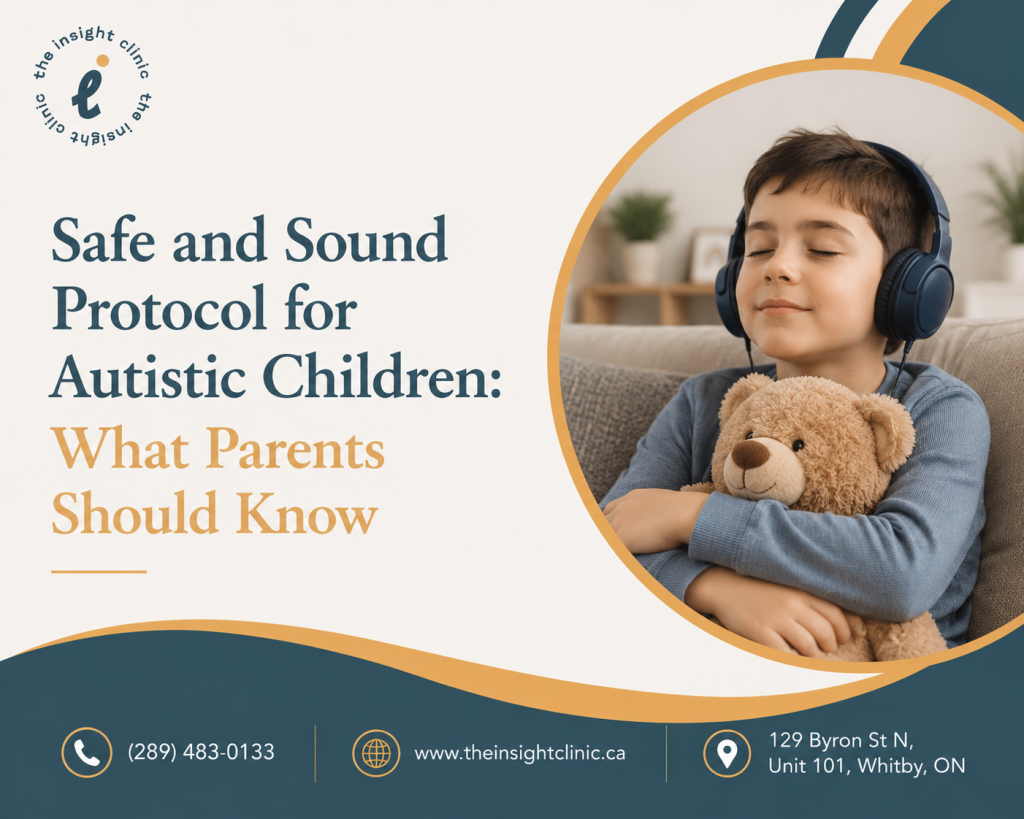
The Safe and Sound Protocol, often called SSP, is a structured listening program that uses digitally processed music. It is designed to support regulation, auditory comfort, and engagement, but research has not established it as a treatment for autism or as a reliable solution for sensory sensitivity. SSP is not a cure for autism and should never be used to pressure a child to appear “less autistic,” tolerate painful sensory experiences, make eye contact, suppress stimming, or perform socially for the comfort of others.
Some families may explore SSP when an autistic child experiences sound sensitivity, sensory overload, anxiety, difficulty with transitions, emotional distress, or challenges settling after demanding experiences. It may be considered as one optional component of a broader, neuroaffirming plan. For parents in Whitby, Durham Region, the GTA, and across Ontario, it can be difficult to determine which autism supports are appropriate. Available options may include environmental accommodations, occupational therapy, speech-language services, psychotherapy, behavioural support, parent coaching, school planning, or other developmental and mental health services.
These services have different purposes, evidence bases, professional requirements, and limitations. SSP should be explained separately and should not be presented as a service every autistic child needs. This article explains what SSP is, what current research does and does not show, what families should consider before beginning, and how SSP can be discussed ethically within autism support.
What Is the Safe and Sound Protocol?
The Safe and Sound Protocol is a commercial listening-based program that uses specially processed music, generally delivered through headphones or another approved listening setup under the guidance of a provider trained in the program. SSP’s proposed rationale is based partly on Polyvagal Theory. This theory attempts to explain relationships between the autonomic nervous system, perceived safety, defensive responses, and social behaviour. Polyvagal Theory is influential in some clinical and wellness settings, but several of its core biological and evolutionary claims remain scientifically debated. It should therefore be described as a proposed framework rather than a settled explanation of how the nervous system works. (Biological Psychology)
SSP music is processed to emphasize and modulate certain acoustic frequencies, including frequencies relevant to human speech. The program’s developers propose that listening to this music may influence auditory processing and autonomic regulation. However, the biological mechanism through which SSP might produce clinical changes has not been established.
It is not accurate to state that SSP has been proven to:
- Stimulate or regulate the vagus nerve
- Retrain the nervous system
- Correct an autistic nervous system
- Improve social engagement
- Reduce anxiety
- Improve auditory processing
- Treat sensory dysfunction
- Prepare every child for therapy
- Produce long-term changes in regulation
These remain proposed or possible effects rather than established outcomes. For an autistic child, SSP may be discussed when sound sensitivity, sensory overload, emotional distress, shutdowns, meltdowns, or difficulty recovering from demanding environments affect daily life.
That does not mean SSP is necessarily the most appropriate starting point.
Before recommending SSP, a provider should consider:
- The child’s individual goals
- The child’s response to sound and headphones
- Communication needs
- Sensory preferences
- Developmental level
- Physical and mental health
- Hearing-related concerns
- Trauma history
- Sleep
- Current stressors
- Family capacity
- Environmental demands
- Other services already involved
- The limited evidence supporting SSP
A responsible SSP process should include:
- Clear information about the evidence and its limitations
- Informed consent from the appropriate decision-maker
- The child’s assent and participation whenever possible
- A flexible pace
- A clear method for stopping
- Permission to refuse or discontinue
- Attention to verbal and nonverbal signs of distress
- Ongoing monitoring
- Discussion of alternatives
- A plan for concerns that arise
SSP should be presented as an optional service, not as a required autism treatment or guaranteed path to regulation.
Why Sensory Regulation Matters in Daily Life
Sensory differences can influence much more than how a child responds to noise.
For many autistic children, sensory experiences affect:
- School participation
- Communication
- Play
- Sleep
- Eating
- Transitions
- Family routines
- Community activities
- Emotional well-being
- Physical comfort
- Social participation
An autistic child who is sensitive to sound may find common environments uncomfortable, painful, exhausting, or unpredictable.
Examples may include:
- Classrooms
- School assemblies
- Grocery stores
- Birthday parties
- Restaurants
- Sports practices
- Public transportation
- Family gatherings
- Hand dryers
- Fire alarms
- Vacuum cleaners
- Several people speaking at once
Even when a child appears calm externally, they may be using significant effort to manage sound, movement, lighting, spoken instructions, social expectations, and changes in routine. Sensory overload may affect:
Emotional regulation
A child may cry, become irritable, withdraw, freeze, shut down, become agitated, or have difficulty communicating what feels wrong.
Learning
Noise and competing sensory input may make it harder to listen, process language, follow instructions, remember information, or complete work.
Behaviour
Avoidance, leaving, covering the ears, refusal, or not responding may communicate discomfort, confusion, fear, pain, or overload.
Sleep
A demanding day may affect the child’s ability to settle, although sleep difficulties can also have medical, behavioural, environmental, or emotional causes.
Social participation
A child may want connection but avoid settings where the sensory or communication demands are too high.
Family functioning
Parents may feel uncertain about whether to leave an environment, reduce demands, encourage participation, seek assessment, or try a particular intervention.
Confidence and self-understanding
Children may begin to believe they are the problem when environments repeatedly exceed their capacity or fail to accommodate their needs. CDC and NIMH describe sensory reactivity as one possible feature of autism, while emphasizing that autistic children have widely different strengths and support needs. (CDC; NIMH)
The goal of sensory support should not be to make a child endure distress for the convenience of other people.
The goal should be to:
- Understand the child’s sensory experience
- Reduce avoidable barriers
- Improve communication
- Increase predictability
- Support meaningful participation
- Provide accommodations
- Help the child recognize and communicate needs
- Protect dignity and autonomy
Signs It May Be Helpful to Explore Support
Not every sensory difference requires therapy. Some sensory preferences can be supported through accommodations, routines, communication tools, environmental changes, and greater understanding from adults. It may be helpful to speak with a qualified professional when sensory experiences begin significantly affecting daily functioning.
Families may notice:
- Frequent distress in noisy environments
- Covering the ears or leaving rooms
- Freezing, hiding, crying, or becoming agitated around particular sounds
- Shutdowns or meltdowns after school, outings, or social events
- Difficulty recovering after unexpected noise
- Avoiding activities because of the sensory environment
- Strong distress related to hand dryers, alarms, vacuums, crowds, or other sounds
- Increased anxiety around unfamiliar environments or transitions
- Sleep difficulties following demanding days
- Increasing stress around school attendance or community activities
- Behaviour that may communicate pain, fear, overload, or loss of control
These experiences do not automatically mean that SSP is appropriate.
They may point to questions such as:
- Does the child need a hearing evaluation?
- Are physical discomfort or medical concerns present?
- Would environmental accommodations be enough?
- Are communication supports needed?
- Could occupational therapy be helpful?
- Are anxiety, trauma, sleep, or school stress contributing?
- Does the child need a different developmental or mental health service?
- Are adults expecting the child to tolerate an inaccessible environment?
Depending on the child, appropriate options may include:
- Environmental accommodations
- Occupational therapy
- Speech-language services
- Psychotherapy
- Parent coaching
- Behavioural support
- School planning
- Medical or hearing assessment
- Communication supports
- SSP as an optional listening program
- Another individualized service
These options are not interchangeable. Families in Ontario may also explore school-based support, community programs, and Ontario Autism Program pathways. Eligibility, access, funding, and provider requirements depend on the specific program and may change over time. (Ontario Autism Program)
What Research Says About SSP and Autism
Research on the Safe and Sound Protocol is still developing, but early studies offer encouraging reasons to continue exploring how structured listening programs may support some autistic individuals. Available research has examined areas such as auditory sensitivity, sensory processing, social engagement, and everyday regulation. Some participants and caregivers have reported positive changes following SSP or related listening-based programs. These findings suggest that SSP may be worth considering for carefully selected children when it is introduced gradually, monitored closely, and connected to meaningful daily-life goals.
At the same time, the current evidence remains preliminary. Existing studies have generally involved small samples, different age groups, short follow-up periods, and outcomes based partly on caregiver or participant reports. More independent, controlled research is needed to understand which children may benefit, what changes may be expected, and how long any improvements may last.
Early Research on Listening-Based Support
A 2014 study examined the Listening Project Protocol, an earlier intervention related to the development of SSP. The study included controlled trials involving autistic children and reported reductions in parent-rated auditory sensitivity among some children who received filtered music.
These early findings helped generate interest in whether structured listening experiences could support children who experience sound-related distress. However, the intervention was a precursor to the current SSP program, several outcomes relied on parent-completed measures, and the authors described the results as preliminary. (PubMed)
The study does not prove that SSP will reduce auditory sensitivity for every child, but it provides an early basis for continued investigation.
Research Involving Children and Adults
A later prospective study included 37 autistic participants between the ages of 7 and 39. Participants or their caregivers reported changes in several sensory and functional areas after completing SSP, including areas related to auditory sensitivity. These results are encouraging because they suggest that some individuals may experience meaningful changes during or after the program. However, the study did not include a randomized comparison group. This means it cannot determine whether SSP alone caused the reported improvements or whether other factors also contributed. (Journal on Developmental Disabilities)
The researchers identified SSP as a promising area for further study and emphasized the need for larger controlled trials.
Exploratory Research With Autistic Adults
A small pilot study involving six autistic adults also explored SSP. The study reported improvement on one family-rated measure related to social awareness. Because the sample was very small and the findings were not consistent across all measures, the results should be viewed as exploratory rather than conclusive. (MDPI)
This study adds to the developing research but does not establish that SSP improves social communication or sensory regulation for autistic children.
What Broader Sound-Therapy Research Tells Us
A Cochrane review examined auditory integration training and other older listening-based interventions for autism. The review found that the available studies were small and inconsistent and did not provide enough evidence to support those approaches as established autism treatments. SSP was not directly evaluated in those studies and is different from the programs reviewed. (Cochrane)
However, the review reinforces the importance of continuing to study listening-based interventions through well-designed, independently replicated research.
A Balanced and Encouraging Perspective
The current evidence does not support presenting SSP as a proven treatment for autism, anxiety, auditory sensitivity, or emotional regulation. It does, however, suggest that structured listening may be a meaningful area to explore for some individuals. Families who are interested in SSP can consider it as an optional, emerging support within a broader care plan.
The most appropriate approach is to:
- Begin with individualized goals
- Introduce listening gradually
- Respect the child’s communication and assent
- Monitor comfort and daily functioning
- Adjust or stop the program when needed
- Continue environmental accommodations and other appropriate supports
- Review whether the program is providing meaningful value
For some children, SSP may become one useful part of a larger support plan. For others, occupational therapy, communication support, psychotherapy, parent coaching, school accommodations, or environmental changes may be more appropriate. The goal is not to promise a particular outcome. It is to explore whether SSP is a comfortable, relevant, and worthwhile option for the individual child and family.
How SSP Might Fit Into an Individualized Plan
SSP is often described as a nervous-system-focused intervention. This description reflects the program’s theory and marketing. It should not be interpreted as proof that SSP directly regulates the autonomic nervous system or vagus nerve.
A more accurate description is: SSP provides repeated exposure to specially processed music within a structured and supportive listening context. Researchers are still studying whether and how this may affect sensory experience or functioning.
Families may explore SSP in relation to individualized goals such as:
- Observing the child’s comfort with structured listening
- Understanding sound-related triggers
- Supporting predictable routines
- Monitoring recovery after sensory demands
- Identifying accommodations
- Improving communication about discomfort
- Supporting parent awareness of early stress cues
It is not appropriate to promise that SSP will:
- Increase tolerance for sound
- Prevent meltdowns
- Improve communication
- Make therapy more effective
- Improve school participation
- Reduce anxiety
- Increase social interest
- Correct auditory processing
- Change the child’s nervous system
These may be areas that families choose to observe, but they are not predictable outcomes.
Progress should never be defined as:
- More eye contact
- Less stimming
- Greater compliance
- Suppression of distress
- Remaining in painful environments
- Appearing more neurotypical
A child who continues to need accommodations after SSP has not failed.
Is SSP Appropriate for Every Autistic Child?
No. SSP is not automatically appropriate for every autistic child.
Before beginning, the provider and family should consider:
- Can the child tolerate headphones or the proposed listening equipment?
- Does the child enjoy or accept the music?
- Can the child communicate discomfort through speech, gesture, AAC, movement, behaviour, or facial expression?
- Can the child stop the session easily?
- Will refusal be respected?
- Is the child experiencing significant hearing-related or medical concerns?
- Is the child currently under unusual stress?
- Are sleep, medication, pain, illness, or environmental changes affecting functioning?
- Does the family understand the limited evidence?
- Are less intensive accommodations available?
- Is the proposed goal meaningful to the child and family?
- Is there a clear plan for monitoring and discontinuation?
Some children may initially tolerate listening and later refuse. Consent and assent are ongoing processes. Previous participation does not mean a child must continue.
For some children, a more appropriate first step may be:
- Reducing environmental noise
- Providing hearing protection
- Improving communication supports
- Increasing predictability
- Supporting sleep
- Addressing anxiety
- Consulting an occupational therapist
- Obtaining a hearing or medical evaluation
- Supporting parents and school staff
- Reducing unnecessary demands
A responsible provider should not present SSP as the only option.
What Parents Should Expect During SSP
SSP delivery varies according to the program model, provider, child, and family.
Before beginning, the provider should explain:
- What the program involves
- The proposed listening schedule
- Where listening will occur
- What equipment is used
- Who supervises the service
- What training the provider has
- Whether the service constitutes psychotherapy
- How the child can stop
- What will be monitored
- What evidence supports the recommendation
- What the limitations are
- What the total fees will be
- What alternatives are available
Families may be asked to observe areas such as:
- Willingness to participate
- Comfort during listening
- Sleep
- Appetite
- Energy
- Emotional distress
- Sensory sensitivity
- Recovery after listening
- Participation in routines
- Communication
- Changes in other treatments or daily demands
These observations should not be interpreted automatically as proof that SSP is working.
For example:
- Fatigue is not necessarily a therapeutic response.
- Increased emotional expression is not necessarily “release.”
- Greater sensitivity is not proof that the nervous system is reorganizing.
- Temporary calm during music does not establish long-term benefit.
- A difficult reaction should not automatically be framed as part of healing.
Current research does not establish a predictable pattern of positive or negative responses. If the child becomes distressed, nauseated, unusually fatigued, more sensitive, agitated, withdrawn, unable to sleep, or unwilling to continue, the provider and family should pause and reassess.
The appropriate response may be to:
- Stop the session
- Reduce demands
- Review possible medical or environmental factors
- Consult another professional
- Change the plan
- Discontinue SSP
Parents should not be instructed to ignore distress or complete the program at all costs.
Questions Parents Can Ask the SSP Provider
Before beginning, parents may ask:
- What specific concern is SSP intended to address?
- What evidence supports using it for this concern?
- Is the recommendation based on research or the provider’s clinical experience?
- What evidence does not support the recommendation?
- What qualifications does the provider have?
- Is the provider a regulated health professional?
- Does this service constitute psychotherapy?
- How is the child’s assent respected?
- What happens if the child refuses?
- What signs would lead you to stop the program?
- What unwanted responses have been reported?
- How will changes be measured?
- What other services or accommodations could be considered?
- What is the total cost?
- Does the provider have any financial relationship with the program manufacturer?
- How will the family decide whether continuing is worthwhile?
Families should receive clear answers without pressure.
How Other Supports May Work Alongside or Instead of SSP
Many autistic children benefit from support that addresses their communication, sensory environment, learning, mental health, relationships, and daily routines. SSP is not a replacement for these services.
Autism-Informed Support
Autism-informed support should begin with understanding:
- The child’s strengths
- Communication style
- Sensory experiences
- Interests
- Developmental needs
- Daily environment
- Family priorities
- The child’s own preferences and goals
A neuroaffirming approach does not attempt to remove autism. It supports safety, communication, self-advocacy, participation, and quality of life.
Occupational Therapy
An occupational therapist may assess how sensory experiences, motor skills, daily activities, self-care, school demands, and environmental factors affect participation. Occupational therapy is a regulated health service and is different from SSP and psychotherapy. The occupational therapist should explain the evidence and purpose of any sensory intervention being recommended.
Behavioural Services
Behavioural services may support communication, daily living, routines, safety, learning, or other meaningful skills. Behavioural approaches vary widely.
Ethical services should:
- Address meaningful functional goals
- Consider sensory and communication needs
- Respect assent
- Avoid coercion
- Avoid suppressing harmless autistic behaviour
- Avoid defining compliance as the primary goal
- Include family input
- Review whether goals improve quality of life
Behavioural services should not be used simply to make a child appear less autistic.
Parent Coaching
Parent coaching may help caregivers:
- Interpret behaviour as communication
- Prepare for transitions
- Support co-regulation
- Adjust routines
- Reduce unnecessary demands
- Respond to overload
- Build communication supports
- Coordinate with school or other providers
Parent coaching may be educational, behavioural, or psychotherapeutic depending on the provider, purpose, and content. The nature of the service should be clearly explained.
Psychotherapy and Play-Based Support
Some autistic children may benefit from psychotherapy when concerns such as anxiety, trauma, grief, self-esteem, emotional distress, family stress, or relationship difficulties are present.
Struggling to Relax or Switch Off?
Learn how anxiety might be affecting your nervous system and daily life.
Psychotherapy should be adapted to the child’s:
- Communication style
- Developmental level
- Sensory needs
- Interests
- Processing pace
- Emotional safety
Psychotherapy is different from SSP.
Speech-Language Services
Speech-language pathologists may support:
- Spoken language
- Alternative or augmentative communication
- Social communication
- Comprehension
- Expression
- Functional communication
- Communication access across environments
Speech-language services should not focus solely on making communication appear typical.
Neurofeedback and qEEG Brain Mapping
Some families may separately explore neurofeedback or qEEG brain mapping. Neurofeedback provides feedback based on measured EEG activity. qEEG uses mathematical methods to analyze characteristics of an EEG recording.
These services do not:
- Diagnose autism
- Identify the cause of sensory sensitivity
- Read thoughts
- Determine which service a child needs
- Establish that SSP or neurofeedback will be effective
- Replace an autism, psychological, psychoeducational, occupational therapy, medical, or hearing assessment
Research is not sufficient to establish neurofeedback as a standard autism intervention. If offered, it should be presented as an optional and separately explained service.
School and Environmental Support
Changing the environment may be one of the most useful interventions for sensory distress.
Possible supports include:
- Noise-reducing headphones
- Ear defenders
- Quiet spaces
- Visual schedules
- Transition warnings
- Flexible seating
- Reduced verbal instructions
- Written or visual directions
- AAC access
- Sensory breaks
- Alternative participation options
- Advance notice of alarms or assemblies when possible
- Reduced exposure to unnecessary noise
- Permission to leave overwhelming environments
SSP should not replace reasonable school or environmental accommodations.
Individual Goals and Changes That May Be Monitored
SSP does not guarantee a specific result. If a family chooses to try it, the provider and family should identify practical goals before beginning.
Possible areas to observe may include:
- The child’s willingness to participate
- Comfort during listening
- Ability to communicate “stop,” “break,” or “too loud”
- Recovery after demanding activities
- Use of sensory supports
- Participation in one specific routine
- Frequency or intensity of distress in a defined situation
- Sleep or energy patterns
- Family confidence in recognizing early overload
- Whether the listening process adds stress
- Whether the program is worth continuing
Goals should be specific.
For example:
- “The child will use a communication card to request a break.”
- “The family will track distress during one weekly community activity.”
- “The school and family will use the same transition-warning system.”
- “The child will be able to stop listening immediately when they indicate discomfort.”
- “The family will review after two weeks whether the service is tolerable and useful.”
Any changes should be interpreted in context.
Other factors may include:
- Environmental accommodations
- School changes
- Sleep
- Illness
- Medication
- Family stress
- Other therapies
- Maturation
- Changes in routine
- Increased parent understanding
Monitoring must include the possibility that SSP does not help or is not a suitable fit.
How The Insight Clinic Approaches SSP and Autism Support
At The Insight Clinic in Whitby, support for autistic children is approached through an integrated and assessment-informed lens.
Families may seek help related to:
- Sound sensitivity
- Sensory overload
- Emotional distress
- Communication
- Anxiety
- Behaviour
- School participation
- Sleep
- Transitions
- Family routines
- Autism support
- Questions about SSP
The goal should not be to place every child into the same program.
The first step should be to understand:
- What the child may be communicating
- What environments create difficulty
- What accommodations are already in place
- What the family hopes will change
- Whether the goal is meaningful and realistic
- Which professional discipline is most appropriate
- Whether SSP is necessary at all
Depending on the child’s needs, services may include:
- SSP as an optional listening-based program
- Parent coaching
- Psychotherapy
- Behavioural support
- Occupational therapy through an appropriate provider
- Speech-language support through an appropriate provider
- School consultation
- Neurofeedback or qEEG as separately explained optional services
- Other developmental or medical services
These services may be provided by different regulated or non-regulated professionals and are not all psychotherapy services.
Families should be informed:
- Who provides each service
- The provider’s qualifications
- Whether the service constitutes psychotherapy
- The evidence supporting it
- The limitations
- The fees
- The expected time commitment
- How progress or distress will be monitored
- What alternatives are available
A recommendation for SSP should not be used to imply that the child automatically needs several other clinic services or a complete package.
Choosing Autism Support in Ontario
Families in Ontario may encounter:
- Private clinics
- School-based services
- Ontario Autism Program pathways
- Community agencies
- Developmental services
- Behavioural services
- Mental health services
- Occupational therapy
- Speech-language services
- Medical services
The Ontario Autism Program currently includes several service pathways, including core clinical services, foundational family services, caregiver-mediated programs, school-transition support, and urgent-response services. Eligibility, invitations, funding, and provider requirements vary by service. Families should verify current information directly through Ontario’s official program resources. (Ontario Autism Program)
When considering any service, parents may ask:
- What need is this service intended to address?
- Is the provider qualified?
- Is the approach neuroaffirming?
- How is assent respected?
- What happens if the child becomes distressed?
- Are the goals meaningful to the child and family?
- Are sensory accommodations included?
- Is the evidence described accurately?
- Are the limitations explained?
- How is progress reviewed?
- What alternatives are available?
- Are claims realistic?
- Does the provider benefit financially from recommending additional services?
The Canadian Paediatric Society emphasizes individualized planning, management of co-occurring needs, developmental and behavioural support, and family-centred care for autistic children. (Canadian Paediatric Society)
A thoughtful plan should consider the whole child, including:
- Communication
- Sensory needs
- Learning
- Emotional well-being
- Sleep
- Physical health
- Behaviour
- Relationships
- Family stress
- Daily routines
- Environment
Ethical Limits of SSP
SSP should not be described as:
- A cure for autism
- A treatment that corrects the autistic nervous system
- A replacement for autism assessment
- A replacement for hearing or medical evaluation
- A replacement for occupational therapy
- A replacement for school accommodations
- A guaranteed treatment for auditory sensitivity
- A proven method for reducing anxiety
- A way to stop stimming
- A way to increase compliance
- A method for producing eye contact
- A stand-alone solution for complex developmental needs
- A program that works the same way for every child
SSP should not be forced on a child who is distressed by the listening process.
Possible signs that require attention include:
- Refusal
- Crying
- Withdrawal
- Agitation
- Shutdown
- Attempts to remove the headphones
- Changes in sleep
- Increased sensitivity
- Physical discomfort
- Nausea
- Headache
- Unusual fatigue
- Increased distress
These signs do not necessarily prove that SSP caused the reaction, but they should not be dismissed or reframed automatically as therapeutic progress.
Ethical care includes:
- Respecting communication in all forms
- Supporting sensory safety
- Avoiding pressure to mask
- Using flexible pacing
- Providing a clear stopping process
- Including parents in informed decision-making
- Reassessing fit throughout the program
- Discontinuing when the service is not tolerable or useful
- Referring to another professional when appropriate
Families deserve balanced information. Hope can be offered without exaggerating the evidence.
Common Mistakes When Exploring SSP
These concerns are understandable and are not intended to blame families.
1. Looking for One Quick Solution
Sensory distress, anxiety, communication, sleep, and behaviour may be influenced by many interacting factors. One listening program is unlikely to address every need.
2. Treating Behaviour as the Entire Problem
Behaviour may communicate:
- Pain
- Fear
- Overload
- Fatigue
- Confusion
- Communication difficulty
- Loss of predictability
- An inaccessible environment
Support should explore what may be contributing.
3. Overlooking Environmental Change
A child may function better when adults reduce noise, improve communication, increase predictability, and offer meaningful breaks. The child should not carry the full responsibility for adapting to an inaccessible environment.
4. Assuming SSP Is Appropriate for Every Autistic Child
Some families may choose to explore SSP. Others may decide that environmental accommodations, occupational therapy, communication support, psychotherapy, or another service is more appropriate.
5. Ignoring Parent and Family Support
Caregivers may need practical assistance understanding overload, preparing for transitions, communicating with schools, and making routines more manageable.
6. Not Asking About Qualifications
“SSP provider” training does not necessarily mean that the person is a regulated health professional or qualified to assess autism, trauma, hearing, or mental health. Families should ask about the provider’s complete qualifications and professional scope.
7. Confusing Increased Tolerance With Better Support
The goal should not be to make a child endure painful or overwhelming environments.
Improved support may mean:
- Leaving earlier
- Using headphones
- Communicating a need for a break
- Participating differently
- Reducing exposure
- Changing adult expectations
Practical Strategies Families Can Try
These strategies are general and educational. They do not replace individualized assessment or care.
1. Observe Sensory Patterns
Notice when sound sensitivity appears more intense.
Possible factors include:
- Time of day
- Fatigue
- Hunger
- School
- Crowds
- Transitions
- Illness
- Unfamiliar settings
- Several simultaneous demands
Observing a pattern does not prove its cause, but it may help identify useful adjustments.
2. Give Predictable Warnings
When possible, warn the child before a loud or unexpected sound.
For example:
“The blender will be loud. You can go to the other room or use your headphones.”
3. Offer Noise-Reducing Tools Without Shame
Noise-reducing headphones, ear defenders, quiet spaces, and sensory breaks are accessibility supports.
They are not signs of failure.
4. Plan Recovery Time
Some children need lower-demand time after school, therapy, appointments, parties, or errands.
Recovery time may include:
- Quiet
- Familiar activities
- Reduced conversation
- Movement
- Rest
- A predictable routine
- Access to preferred sensory input
5. Support Regulation Before Teaching
A highly distressed child may not be ready for explanations, problem-solving, or demands.
Helpful first steps may include:
- Fewer words
- Reduced stimulation
- Familiar communication
- Space
- Predictability
- Access to a trusted adult
- A clear way to leave or pause
6. Make Communication Easier
The child may need:
- Visuals
- Gestures
- AAC
- Choice boards
- Communication cards
- Simple phrases such as “too loud,” “stop,” “break,” or “help”
Communication supports should remain available during distress.
7. Prepare for New Environments
Depending on the child, preparation may include:
- Photos
- Maps
- Social information
- Short introductory visits
- A clear schedule
- Advance information about noise
- A plan for leaving
- Access to sensory tools
8. Respect the Child’s Refusal
A child’s “no” may be communicated through:
- Speech
- Gesture
- AAC
- Turning away
- Removing headphones
- Leaving
- Crying
- Freezing
- Agitation
- Withdrawal
Refusal should be taken seriously. The next question should be what feels difficult and what could make the experience safer—not how to force tolerance.
When to Seek Professional Support
It may be helpful to speak with a qualified professional when sensory sensitivity, anxiety, emotional distress, communication difficulties, or behaviour substantially interfere with daily life.
Professional consultation may be useful when:
- Everyday sounds frequently cause significant distress
- School attendance or participation is affected
- Shutdowns or meltdowns are becoming more frequent
- The child has difficulty recovering after stress
- Family routines are becoming difficult to maintain
- The child appears anxious, withdrawn, physically uncomfortable, or exhausted
- There are concerns about hearing, sleep, pain, or physical health
- The family is unsure which type of service is appropriate
- Home, school, and therapy goals need coordination
- Current supports are not sufficient
A qualified professional can help determine whether the next step may involve:
- Environmental accommodations
- Hearing or medical assessment
- Occupational therapy
- Speech-language services
- Psychotherapy
- Behavioural support
- Parent coaching
- School planning
- SSP as an optional listening program
- Another individualized service
These services are not interchangeable and may require different professionals. When there is an immediate risk of harm, a medical emergency, or an urgent safety concern, families should seek emergency or crisis support rather than waiting for a routine appointment.
Conclusion
The Safe and Sound Protocol is a listening-based program informed partly by Polyvagal Theory and designed around digitally processed music. Early research offers encouraging reasons to continue studying whether SSP may support sensory comfort, regulation, or daily functioning for some autistic individuals. However, the current evidence remains preliminary and does not establish SSP as a proven treatment for autism, auditory sensitivity, anxiety, emotional regulation, or social engagement.
Some families may choose to explore SSP as an optional component of a broader plan after receiving clear information about:
- The developing evidence
- The proposed and uncertain mechanism
- The provider’s qualifications
- The child’s assent
- Possible distress
- Monitoring
- Costs
- Alternatives
- The right to pause or discontinue
SSP should not be used to make an autistic child appear less autistic or tolerate environments that remain painful or inaccessible. For families in Whitby, Durham Region, the GTA, and across Ontario, the most useful plan is one that begins with the individual child: their communication, sensory experience, strengths, environment, comfort, support needs, and meaningful daily goals.
FAQ
1. What is the Safe and Sound Protocol for autistic children?
The Safe and Sound Protocol is a listening-based program that uses specially filtered music under provider guidance. For some autistic children, it may support regulation and auditory sensitivity. It should be used as part of a thoughtful care plan, not as a cure for autism.
2. Can SSP reduce auditory sensitivity in autistic children?
Some early studies suggest SSP or related listening-based protocols may help with auditory sensitivity for some people, but the research is still limited. Outcomes vary, and SSP should not be presented as a guaranteed solution.
3. Is SSP safe for autistic children?
SSP may be appropriate for some autistic children when delivered by a trained provider with careful screening, flexible pacing, and parent involvement. It may not be appropriate for every child, especially if headphones, sound exposure, or the listening process cause significant distress.
4. How do I know if my child is ready for SSP?
Readiness may depend on whether your child can tolerate the listening setup, communicate discomfort, pause when needed, and receive support before and after listening. A qualified provider can help determine whether SSP is appropriate.
5. Does SSP replace ABA therapy, parent coaching, or school supports?
No. SSP should not replace autism support, ABA therapy, parent coaching, communication supports, occupational therapy, school accommodations, or mental health care when those are needed. It may be one part of a broader plan.
6. Is SSP available in Whitby or Durham Region?
The Insight Clinic in Whitby offers Safe and Sound Protocol services as part of broader nervous system-focused and autism support options for families in Durham Region, the GTA, and Ontario.
7. Can SSP help with social engagement?
SSP is designed around nervous system regulation and social engagement, and some families report changes in readiness for connection. However, social goals should be neuroaffirming and should not pressure autistic children to mask, force eye contact, or suppress natural communication.
8. What should parents expect after SSP?
Some children may seem calmer, more tired, more sensitive, or more emotionally expressive during or after SSP. Parents should track changes and communicate with the provider. The pace may need to be adjusted, paused, or integrated with other supports.

Clinical Review by Gretchen Savery
Gretchen Savery, Registered Psychotherapist (Qualifying), supports The Insight Clinic’s blog review and approval process by helping ensure content is accurate, thoughtful, and aligned with professional standards, including CRPO expectations around ethical communication, client confidentiality, and responsible mental health education. Her role helps strengthen the quality, clarity, and trustworthiness of the clinic’s educational resources.

Blog Writer Bio — Dr. Betsy Bautista
Dr. Betsy Bautista is an experienced medical doctor and mental health counsellor contributing educational content for The Insight Clinic. With a strong background in supporting adults and seniors, she brings clinical insight, compassion, and a deep understanding of emotional health, aging, grief, chronic illness, family relationships, anxiety, depression, and life transitions. Her writing helps make complex mental health topics easier to understand while supporting The Insight Clinic’s commitment to thoughtful, accessible, and evidence-informed education.