Table of Contents
- What Is Neurofeedback?
- What Is At-Home Neurofeedback?
- What Is In-Clinic Neurofeedback?
- Why This Matters in Real Life
- At-Home Neurofeedback vs. In-Clinic Neurofeedback: What Is the Difference?
- How Brain Mapping Can Support Neurofeedback Planning
- What the Research Says
- Is At-Home Neurofeedback Safe?
- When Professional Support May Be Helpful
- How Supervised Neurofeedback May Work
- Individual Goals and Responses That May Be Monitored
- Common Mistakes Parents or Adults Make
- Choosing the Right Neurofeedback Support in Ontario
- When to Seek Professional Support
- FAQ
At-home neurofeedback can be convenient, but it is not the same as supervised clinical neurofeedback. Home devices may be designed for general brain-training or wellness goals, while in-clinic neurofeedback may include assessment, brain mapping, individualized protocol planning, clinician monitoring, and ongoing adjustments. For children, teens, adults, or families managing ADHD, anxiety, sleep concerns, emotional regulation, trauma-related symptoms, or learning challenges, professional guidance may be especially important before beginning neurofeedback.
The right option depends on the person’s goals, symptoms, age, health history, comfort with technology, and whether their care needs assessment-informed support.
What Is Neurofeedback?
Neurofeedback is a type of biofeedback that focuses on measured brain activity. During neurofeedback, sensors are placed on the scalp to record electrical activity. A computer translates that activity into feedback, such as changes in a video, game, sound, or visual display. The feedback is intended to support learning and self-regulation through repetition and practice. Research continues to examine how neurofeedback works, which protocols may be useful, and for whom. Neurofeedback does not usually involve putting electricity into the brain. In traditional EEG neurofeedback, the sensors record brainwave activity and provide feedback based on the measured signal.
Neurofeedback may be considered as part of a broader support plan when attention, emotional regulation, sleep, stress, anxiety, trauma-related symptoms, or performance goals are concerns. The quality and strength of evidence vary depending on the condition, protocol, and outcome being studied. Outcomes also vary. Neurofeedback should not be described as a cure for ADHD, anxiety, autism, trauma, depression, or any other condition.
What Is At-Home Neurofeedback?
At-home neurofeedback usually refers to one of three options.
Consumer Wellness Devices
These are devices people purchase directly online. They may use a headset, app, or wearable sensor to provide general feedback related to focus, relaxation, meditation, or performance. Consumer devices vary in what they measure, how accurately they record signals, what feedback they provide, and whether their claims are supported by research.
Remote Clinician-Supported Neurofeedback
Some clinics offer home-based neurofeedback with professional oversight. A clinician may complete an intake or assessment, recommend a protocol, monitor data, and make adjustments as needed. The level of monitoring and professional involvement varies between programs.
Hybrid Neurofeedback
Some clients begin with an in-clinic assessment or brain mapping and then complete part of their training at home with clinical monitoring. These options are not equivalent. A consumer headset used independently is different from a clinician-supported program that may include intake, screening, qEEG brain mapping, protocol selection, progress tracking, and professional review. The regulatory status and authorized intended use of the specific device should also be verified. A product being available online does not necessarily mean it is licensed for sale in Canada or authorized for every purpose described in its marketing.
What Is In-Clinic Neurofeedback?
In-clinic neurofeedback is neurofeedback provided in a clinical setting, often after an intake or assessment process.
Depending on the provider and program, it may include:
- Review of symptoms, goals, health history, medication considerations, sleep, stress, and daily functioning
- Brain mapping, also called qEEG, when appropriate
- Selection of a neurofeedback protocol based on the client’s goals and available assessment information
- Supervised training sessions
- Monitoring for fatigue, overstimulation, headaches, mood changes, sleep changes, or other responses
- Adjustments to the protocol based on how the person responds
- Coordination with psychotherapy, parent coaching, ADHD support, or other services when appropriate
Not every clinical neurofeedback program includes all of these components. Clients should ask what assessment, monitoring, professional oversight, and follow-up are included. Professional guidelines for neurofeedback emphasize organized training based on an adequate initial assessment, including pre-training EEG assessment when appropriate, as well as appropriate supervision and support during training. (ISNR)
Why This Matters in Real Life
Families often explore neurofeedback because daily life feels harder than it should. A child may struggle to sit through homework. A teen may feel overwhelmed by school demands. An adult may feel scattered, anxious, burned out, or stuck in cycles of poor sleep and low focus.
These challenges can affect:
- Emotional regulation
- Attention and task completion
- Sleep routines
- School performance
- Work performance
- Parent-child relationships
- Stress tolerance
- Sensory regulation
- Confidence and independence
- Family routines
For some families, at-home neurofeedback feels appealing because it offers flexibility and privacy. It may reduce travel time and make training easier to fit into a busy week. For families in Whitby, Durham Region, the GTA, or other parts of Ontario, remote or hybrid options may also feel more accessible. However, convenience is only one part of the decision. Neurofeedback involves more than using a device. The quality of the assessment, appropriateness of the protocol, monitoring, and follow-through may also matter.
At-Home Neurofeedback vs. In-Clinic Neurofeedback: What Is the Difference?
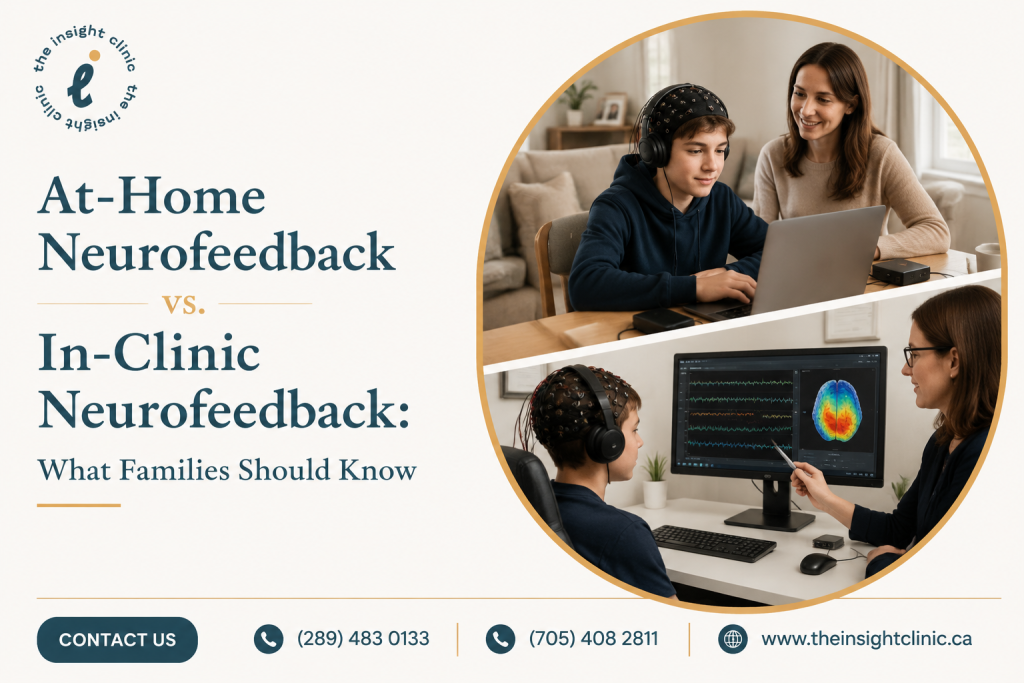
The main difference is usually the setting and level of professional involvement. At-home consumer devices may be designed for general wellness or self-guided practice. Clinician-supported home programs may provide remote assessment and monitoring. In-clinic programs may allow the provider to observe sessions directly and make changes during or between appointments.
The exact services vary significantly by device, provider, and program. The following comparison is general and should be confirmed with the provider.
| Area | At-Home Consumer Device | Clinician-Supported Home Training | In-Clinic Neurofeedback |
| Assessment | Often limited or self-guided | May include intake and clinical review | May include a more structured intake or assessment |
| Brain mapping | Usually not included | May be available | May be available when appropriate |
| Protocol selection | Often preset or app-based | May be clinician-guided | May be clinician-guided |
| Monitoring | Primarily self-directed | Remote monitoring may be included | In-session monitoring may be included |
| Response support | Usually limited to device or technical support | Clinical support may be available remotely | Provider may be available during the session |
| May be considered for | General wellness or self-guided goals consistent with the device’s intended use | People able to complete training at home with professional oversight | People who prefer or require in-person observation and assistance |
| Integration with other services | Usually limited | May be possible | May be possible |
A person’s diagnosis or level of symptom complexity does not automatically determine which setting is appropriate. The decision should consider clinical needs, the device’s intended use, the provider’s qualifications, the available monitoring, the person’s ability to train independently, and individual preferences.
How Brain Mapping Can Support Neurofeedback Planning
Brain mapping, also called quantitative EEG or qEEG, records and analyzes patterns of electrical brain activity. The information can be displayed visually and, in some systems, compared with a normative reference database. For people considering neurofeedback, brain mapping can provide an additional layer of information beyond symptoms alone. It may help the provider look more closely at patterns related to attention, arousal, regulation, sleep, or processing and consider how these patterns fit with the person’s goals and daily functioning.
This can be helpful because two people with similar concerns may have very different needs. For example, two children may both struggle with focus, but one may also experience sleep disruption and anxiety, while the other may have sensory or learning challenges. A broader assessment process allows the provider to consider these differences rather than relying on a generic approach.
Some neurofeedback providers use qEEG findings as one source of information when selecting, reviewing, or adjusting a protocol. The results are considered alongside the person’s history, symptoms, goals, medication, sleep, functioning, and other relevant assessment information.
Brain mapping is not a stand-alone diagnostic test and does not diagnose ADHD, anxiety, autism, trauma, depression, learning disabilities, or other mental health or developmental conditions on its own. Clinical evaluations must continue to rely on appropriate assessment, and professional guidance cautions against using individual EEG measures to confirm an ADHD diagnosis or replace a standard clinical evaluation. (PMC)
Brain mapping also does not guarantee that neurofeedback will be appropriate or that it will produce a particular outcome. Its value is in helping create a more informed and individualized starting point for discussion, planning, and ongoing monitoring. At The Insight Clinic, brain mapping may be considered as one component of neurofeedback planning for clients in Whitby, Durham Region, and surrounding areas. The goal is to combine objective information with the person’s lived experience, clinical history, and functional needs to support thoughtful, individualized care.
What the Research Says
Research on neurofeedback is growing, but findings remain mixed. This is important for families to understand. For ADHD, research has explored whether neurofeedback may affect attention, self-regulation, and executive functioning. A recent JAMA Psychiatry meta-analysis found that current forms of neurofeedback should not be viewed as a stand-alone ADHD treatment based on probably blinded outcomes. It also identified possible signals in certain analyses involving established protocols, which require cautious interpretation. (JAMA Network)
For PTSD, a systematic review and meta-analysis reported beneficial findings in randomized controlled trials, but the evidence base remains relatively small and additional research is needed. (PMC)
For adolescents and adults with ADHD, one pilot meta-analysis found that self-reported effectiveness remains unclear, reinforcing the need for careful expectations and individualized planning. (PMC)
Home-based neurofeedback research is also emerging. Some studies suggest that home-based or remotely supported neurofeedback may be feasible in certain settings. Feasibility does not establish that every home device is clinically appropriate or effective for every person. (PMC)
Consumer-grade EEG devices are becoming more common in research and wellness settings, but reviews note significant differences in signal quality, purpose, software, calibration, and clinical usefulness. Recent research has not supported broad claims that consumer devices reliably allow users to modify brain activity or improve cognition. (PLOS; PubMed)
The main takeaway is balanced: neurofeedback may be considered by some people as part of a broader care plan, but it should not be marketed as a guaranteed solution or as a replacement for medical, psychological, educational, or developmental assessment when those supports are needed.
Is At-Home Neurofeedback Safe?
The safety of at-home neurofeedback varies depending on the device, protocol, training frequency, user, health history, and level of monitoring. A device that is marketed for home use should not automatically be assumed to be safe or appropriate for every person. Some forms of biofeedback are generally described as low risk, but this does not establish the safety of every neurofeedback device or protocol. Mayo Clinic recommends speaking with an appropriate healthcare provider before beginning biofeedback when medical concerns are present. (Mayo Clinic)
Responses reported during or after neurofeedback may include:
- Fatigue
- Headache
- Irritability
- Temporary sleep changes
- Feeling overstimulated
- Feeling unusually tired after training
- Frustration with the equipment or process
- Increased anxiety related to monitoring or performance
This list is not exhaustive, and these experiences may also have causes unrelated to neurofeedback. New, worsening, or concerning symptoms should not be assumed to be a normal part of training. Monitoring allows a qualified provider to consider whether a protocol should be adjusted, paused, or discontinued and whether medical or other clinical assessment is needed. Professional or medical guidance may be particularly important for children and for people with a history of seizures, concussion, neurological conditions, significant trauma symptoms, complex mental health concerns, major sleep disruption, or other medical needs.
Health Canada regulates individual medical devices rather than neurofeedback as a general service or treatment category. Families should verify the regulatory status and authorized intended use of the specific equipment or software being considered. A device licence does not establish that neurofeedback is approved or effective for every condition mentioned in advertising.
When Professional Support May Be Helpful
Professional support may be helpful when neurofeedback is being considered for a child, teen, or adult with clinical or functional concerns.
It may be especially useful to speak with an appropriate qualified professional if:
- Attention challenges affect school, work, or daily routines
- Emotional regulation difficulties are causing distress
- Anxiety, trauma-related concerns, or mood symptoms are present
- Sleep problems are ongoing
- The person has autism, ADHD, learning differences, or sensory processing differences
- There is a history of seizures, concussion, neurological concerns, or complex medical needs
- The person becomes very fatigued, irritable, anxious, or dysregulated after training
- A family is unsure whether neurofeedback, psychotherapy, assessment, parent coaching, medical care, or another service is an appropriate next step
An assessment or consultation may help determine whether neurofeedback is appropriate, whether brain mapping would add useful information, and whether other supports should be considered.
How Supervised Neurofeedback May Work
A supervised neurofeedback plan may include several steps.
1. Intake and Goal Setting
The provider learns about the person’s goals, symptoms, daily routines, stressors, health history, sleep, medication, and previous supports.
For a child, this may also include parent concerns, school observations, developmental history, and family routines.
2. Brain Mapping or Assessment
When appropriate, qEEG brain mapping may be considered as one source of information. Other assessments may also be recommended when learning, attention, autism, trauma, or mental health questions are present.
Brain mapping does not provide a diagnosis or determine a treatment plan on its own.
3. Protocol Planning
The provider selects a neurofeedback protocol based on the person’s goals, history, responses, and available assessment information.
This may involve providing feedback based on selected EEG signals or training targets. The rationale, evidence, limitations, and intended goals of the protocol should be explained to the client or family.
4. Training Sessions
The client completes repeated sessions. In traditional neurofeedback, the person receives real-time feedback while watching a screen, listening to audio, or engaging with a program.
Feeling Mentally Scattered or Overwhelmed?
Learn more about ADHD-related patterns and how they may be impacting you.
5. Monitoring and Adjustment
The provider monitors the client’s response. If the person becomes tired, overstimulated, restless, emotional, or experiences sleep changes, the provider may consider adjusting, pausing, or discontinuing the protocol.
6. Integration With Other Supports
Neurofeedback may be provided alongside psychotherapy, ADHD support, parent coaching, executive-function strategies, trauma therapy, school support, medical care, or other services when each service is individually appropriate.
Receiving neurofeedback does not mean that a client automatically requires these other services.
Individual Goals and Responses That May Be Monitored
Neurofeedback does not guarantee improvement. The following should not be understood as established or expected outcomes. When neurofeedback is considered, clients, families, and providers may identify individual goals and monitor whether meaningful changes occur. Areas that may be monitored include:
- Awareness of stress and regulation patterns
- Ability to settle after stressful situations
- Consistency of attention during identified tasks
- Sleep routines and perceived sleep quality
- Emotional awareness
- Use of coping strategies
- Daily functioning at home, school, or work
- Understanding of how stress, sleep, attention, and the environment interact
Changes, if they occur, may be gradual and may also be influenced by sleep, nutrition, stress, psychotherapy, school or work demands, family routines, medication, physical health, and environmental supports. Monitoring should include the possibility that there may be no meaningful improvement or that the protocol may not be appropriate for the person.
Common Mistakes Parents or Adults Make
1. Choosing a Device Based Only on Marketing
Some home devices use strong claims about focus, calm, performance, or “brain optimization.” Families should look for clear information about what the device measures, what it does not measure, its authorized intended use, what professional support is included, and whether its claims are wellness-based or clinical.
2. Assuming All Neurofeedback Is the Same
Traditional EEG neurofeedback, LENS neurofeedback, app-based brain training, meditation headbands, clinical qEEG recording, and brain mapping are not the same service. It is important to ask exactly what type of device, feedback, protocol, and professional oversight are being offered.
3. Skipping Assessment
When symptoms affect school, work, sleep, mental health, or daily functioning, it may be important to understand the broader clinical and functional picture before beginning training.
4. Expecting a Quick Fix
Neurofeedback is generally offered as a repeated training process rather than a one-session intervention. A recommended number of sessions does not guarantee that the person will experience a particular benefit.
5. Ignoring Sleep and Stress
Sleep, stress, routines, sensory demands, medication, and other health or environmental factors may affect how a person feels during a neurofeedback program and should be considered when reviewing progress.
6. Not Asking About Qualifications
Families can ask who is supervising the neurofeedback, what training they have, whether a regulated professional is involved, who interprets any qEEG data, and how concerns or adverse responses are handled.
7. Treating Behaviour as the Whole Problem
For children, behaviour may be related to regulation, communication, sensory needs, anxiety, learning difficulties, physical discomfort, sleep, or environmental demands. Neurofeedback, when considered, may be only one part of a broader support plan.
Practical Tips Before Starting At-Home Neurofeedback
Clarify the Goal
Are you hoping to address focus, sleep, emotional regulation, stress tolerance, or a general wellness goal? The goal should be specific enough to monitor without assuming a guaranteed outcome.
Ask Whether the Device Is Wellness-Based or Clinical
Some devices are designed for relaxation, meditation, or entertainment rather than for assessing or treating a health condition.
Verify the Device’s Canadian Regulatory Status
Ask for the manufacturer, model, device identifier, licence information, and authorized intended use where applicable.
Do not assume that a device is authorized for treating ADHD, anxiety, trauma, sleep problems, or another condition simply because it records EEG activity or is used by a clinic.
Look for Appropriate Professional Guidance
For children or people with complex health, developmental, or mental health concerns, professional involvement may provide more opportunity for individualized screening, monitoring, and adjustment.
Track Sleep, Mood, Focus, and Energy
A simple weekly log may help identify patterns, changes, or possible concerns. Tracking does not establish that neurofeedback caused a change.
Avoid Overtraining
More training is not necessarily better. Frequency and duration should be consistent with the device instructions, protocol, and the person’s response.
Do Not Stop Medical or Mental Health Care Without Advice
Neurofeedback should not replace prescribed treatment or other necessary care unless changes are recommended by an appropriate qualified professional involved in the person’s care.
Watch for Changes After Sessions
Fatigue, irritability, anxiety, headaches, sleep changes, or other new or worsening concerns should be discussed with an appropriate provider.
Consider Assessment When Concerns Are Complex
A psychoeducational assessment, ADHD assessment, psychotherapy intake, medical consultation, or another appropriate evaluation may help clarify what support fits the person’s needs. Brain mapping should not replace these assessments.
How The Insight Clinic Approaches Neurofeedback and Brain Mapping
At The Insight Clinic in Whitby, neurofeedback is approached as part of a broader, assessment-informed care model. Rather than treating neurofeedback as a one-size-fits-all device-based service, the clinic considers the person’s goals, symptoms, developmental profile, mental health needs, family context, and daily functioning. Depending on the client’s needs, support may include neurofeedback, brain mapping, psychotherapy, EMDR, ADHD support, parent coaching, executive-function strategies, or other assessment services.
These services may be delivered by different qualified professionals and are not all psychotherapy services. Clients should be informed which services constitute psychotherapy, who provides each service, the provider’s qualifications and regulatory status, and how each recommendation relates to the client’s identified needs and goals.
Some clients may consider neurofeedback as part of a structured care plan, while others may benefit from psychotherapy, assessment, school support, medical consultation, or family-based strategies before or instead of neurofeedback.
Receiving one service does not mean that a client automatically requires the others.
For families in Whitby, Durham Region, the GTA, and across Ontario, the goal is to clarify what type of support may be appropriate rather than assume that every person needs the same pathway.
Choosing the Right Neurofeedback Support in Ontario
When choosing neurofeedback in Ontario, families and adults may want to ask:
- Is this a wellness device, remote program, or supervised clinical service?
- What is the specific manufacturer and model of the equipment?
- Is the device licensed or otherwise permitted for sale in Canada, where applicable?
- What is its authorized intended use?
- Is an intake or assessment completed first?
- Is qEEG brain mapping available, and why is it being recommended?
- Who records and interprets the brain map?
- What qualifications does that person have?
- How will the qEEG information be used, and what are its limitations?
- Who selects and reviews the neurofeedback protocol?
- Who monitors symptoms, responses, or possible adverse effects?
- How often are protocols reviewed or adjusted?
- Is the service appropriate for the person’s age and ability to participate?
- Can neurofeedback be coordinated with psychotherapy, ADHD support, parent coaching, medical care, or assessment services when separately appropriate?
- What happens if the person becomes tired, anxious, irritable, or overstimulated?
- Are expectations explained carefully without guarantees?
Comfort and fit matter. A provider should be able to explain the process, qualifications, evidence, limitations, costs, expected time commitment, device status, and available alternatives clearly enough to support informed decision-making.
When to Seek Professional Support
It may be helpful to seek professional support when attention, regulation, sleep, anxiety, mood, trauma-related symptoms, learning, or behaviour patterns affect daily life. For children, support may be helpful when challenges affect school participation, family routines, friendships, emotional regulation, safety, or confidence. For teens and adults, support may be helpful when focus, burnout, sleep, anxiety, emotional overwhelm, or executive-functioning difficulties affect work, school, relationships, or independence.
For older adults, professional assessment may be helpful when cognitive changes, sleep disruption, anxiety, grief, mood changes, or other concerns affect daily functioning or quality of life. New cognitive or neurological changes should be medically assessed rather than assumed to be appropriate for neurofeedback. Seeking professional support does not mean that something is “wrong.” It can help clients and families better understand what is happening and make a more informed decision about the next step.
FAQ
1. Is at-home neurofeedback the same as in-clinic neurofeedback?
No. At-home neurofeedback may involve a consumer device, a remote supervised program, or a hybrid plan. In-clinic neurofeedback usually includes more direct assessment, monitoring, and protocol adjustment. The level of clinical support is the biggest difference.
2. Is at-home neurofeedback safe for children?
It may be low-risk for some children, but professional guidance is recommended when a child has ADHD, autism, anxiety, sleep problems, learning concerns, trauma history, seizure history, or significant emotional regulation difficulties.
3. Do you need brain mapping before neurofeedback?
Not always, but brain mapping can help guide individualized neurofeedback planning. qEEG brain mapping may be especially helpful when symptoms are complex or when a family wants a more assessment-informed approach.
4. Can neurofeedback help ADHD?
Research suggests neurofeedback may support some aspects of attention and regulation for some individuals, but findings are mixed. It should not be viewed as a guaranteed or stand-alone ADHD treatment. ADHD support may also include behavioural strategies, psychotherapy, parent training, school support, medication, or assessment.
5. What is the difference between a home neurofeedback device and supervised clinical neurofeedback?
A home device may offer general feedback through an app. Supervised clinical neurofeedback includes professional intake, individualized planning, monitoring, and protocol adjustment. Clinical support is especially important when symptoms affect daily life.
6. Is neurofeedback available in Whitby or Durham Region?
Yes. The Insight Clinic offers neurofeedback and brain mapping services in Whitby for families in Durham Region, the GTA, and Ontario. The right pathway depends on the client’s goals, age, symptoms, and assessment needs.
7. Can neurofeedback be combined with therapy?
Yes, neurofeedback may be combined with psychotherapy, EMDR, ADHD support, parent coaching, executive function strategies, or assessment services when clinically appropriate. A qualified professional can help determine what combination may fit.
8. How do I know if my family should choose at-home or in-clinic neurofeedback?
At-home options may fit general wellness goals or clinician-supported remote plans. In-clinic neurofeedback may be more appropriate when symptoms are complex, when brain mapping is needed, or when close monitoring would be helpful.

Clinical Review by Gretchen Savery
Gretchen Savery, Registered Psychotherapist (Qualifying), supports The Insight Clinic’s blog review and approval process by helping ensure content is accurate, thoughtful, and aligned with professional standards, including CRPO expectations around ethical communication, client confidentiality, and responsible mental health education. Her role helps strengthen the quality, clarity, and trustworthiness of the clinic’s educational resources.

Blog Writer Bio — Dr. Betsy Bautista
Dr. Betsy Bautista is an experienced medical doctor and mental health counsellor contributing educational content for The Insight Clinic. With a strong background in supporting adults and seniors, she brings clinical insight, compassion, and a deep understanding of emotional health, aging, grief, chronic illness, family relationships, anxiety, depression, and life transitions. Her writing helps make complex mental health topics easier to understand while supporting The Insight Clinic’s commitment to thoughtful, accessible, and evidence-informed education.